Guardly
A Scam-detection and education feature embedded within LinkedIn
INTRODUCTION
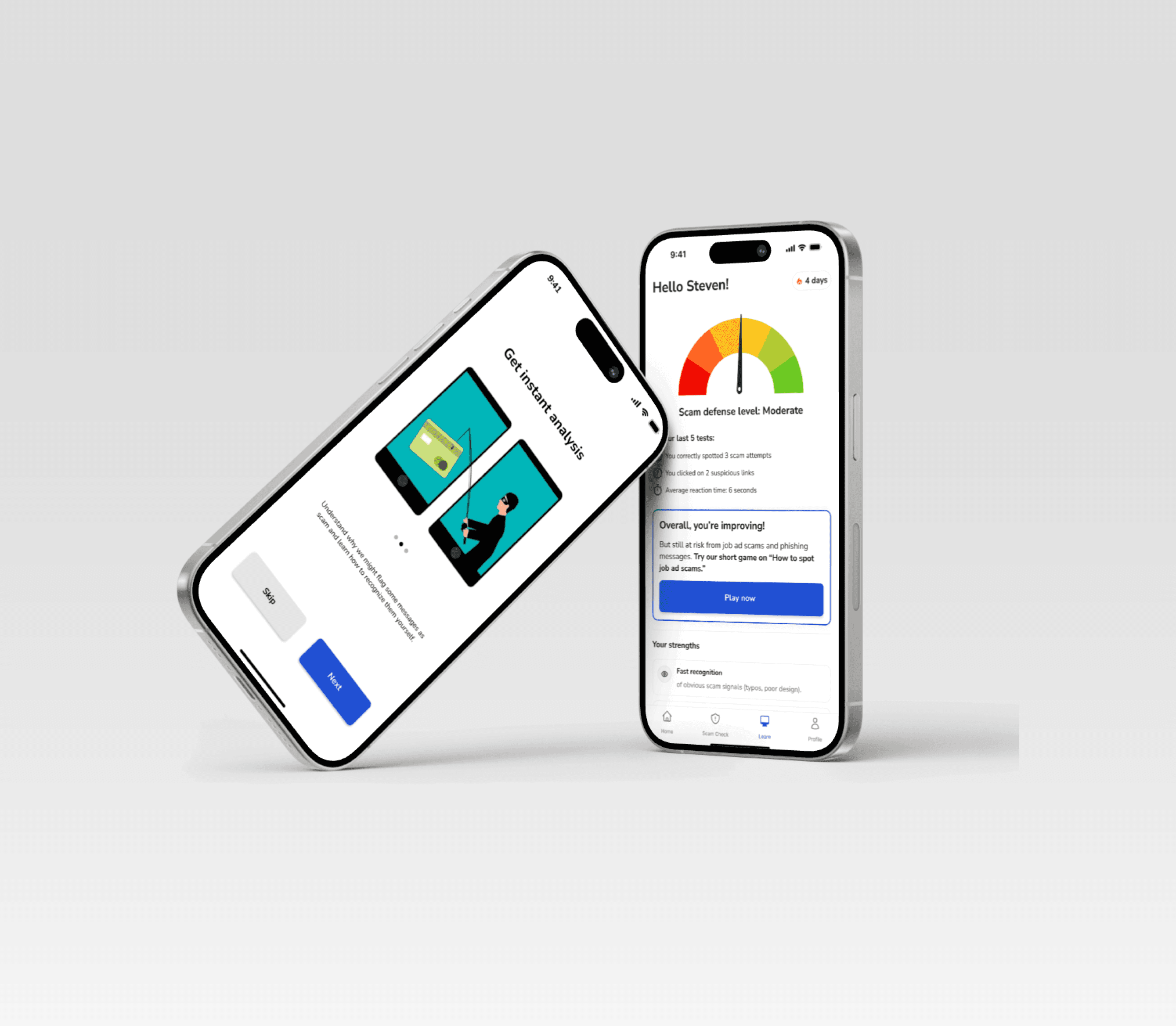
Guardly is a UX-led product developed during a 48-hour designathon, exploring how moment-based interventions can support job seekers at the point where scams are most likely to occur.
MY ROLE
I kept everyone aligned under tight time constraints by prioritising work and coordinating parallel workstreams. I contribute to the UX research and problem-definition phase, including framing the core challenge, sourcing supporting data, and shaping user interview questions.
I also owned the product narrative and final presentation to the judging panel, defining the story and communicating Guardly’s value and feasibility.
INTRODUCTION
Guardly is a UX-led product developed during a 48-hour designathon, exploring how moment-based interventions can support job seekers at the point where scams are most likely to occur.
[Project Scope]
Team of 5
[Role]
UX Designer - Product Manger
[Timeline]
48 hours designathon
View prototype
PROBLEM DISCOVERY
Job Scams look real and they catch people at their moment vunerable
Job scams no longer look suspicious. They look like real opportunities — complete with polished job listings, interviews, and official-looking offer letters. The danger often appears late in the process, during payroll onboarding, when job seekers are asked to share personal identification and bank details.
This makes scams especially effective during the job search, a time filled with urgency, hope, and emotional pressure. Many people are confident they won’t fall for scams until they find themselves caught in one.
This sparked a question -
“How might we empower users to confidently spot and report job scams so they can protect their personal information from online predators?”
PROBLEM DISCOVERY
Job Scams look real and they catch people at their moment vunerable
Job scams no longer look suspicious. They look like real opportunities — complete with polished job listings, interviews, and official-looking offer letters. The danger often appears late in the process, during payroll onboarding, when job seekers are asked to share personal identification and bank details.
This makes scams especially effective during the job search, a time filled with urgency, hope, and emotional pressure. Many people are confident they won’t fall for scams until they find themselves caught in one. This sparked a question -
“How might we empower users to confidently spot and report job scams so they can protect their personal information from online predators?”
Our Solution - Guardly
A moment-based scam detection and education experience for job seekers
Timely warning and clear guidance right when it matters most
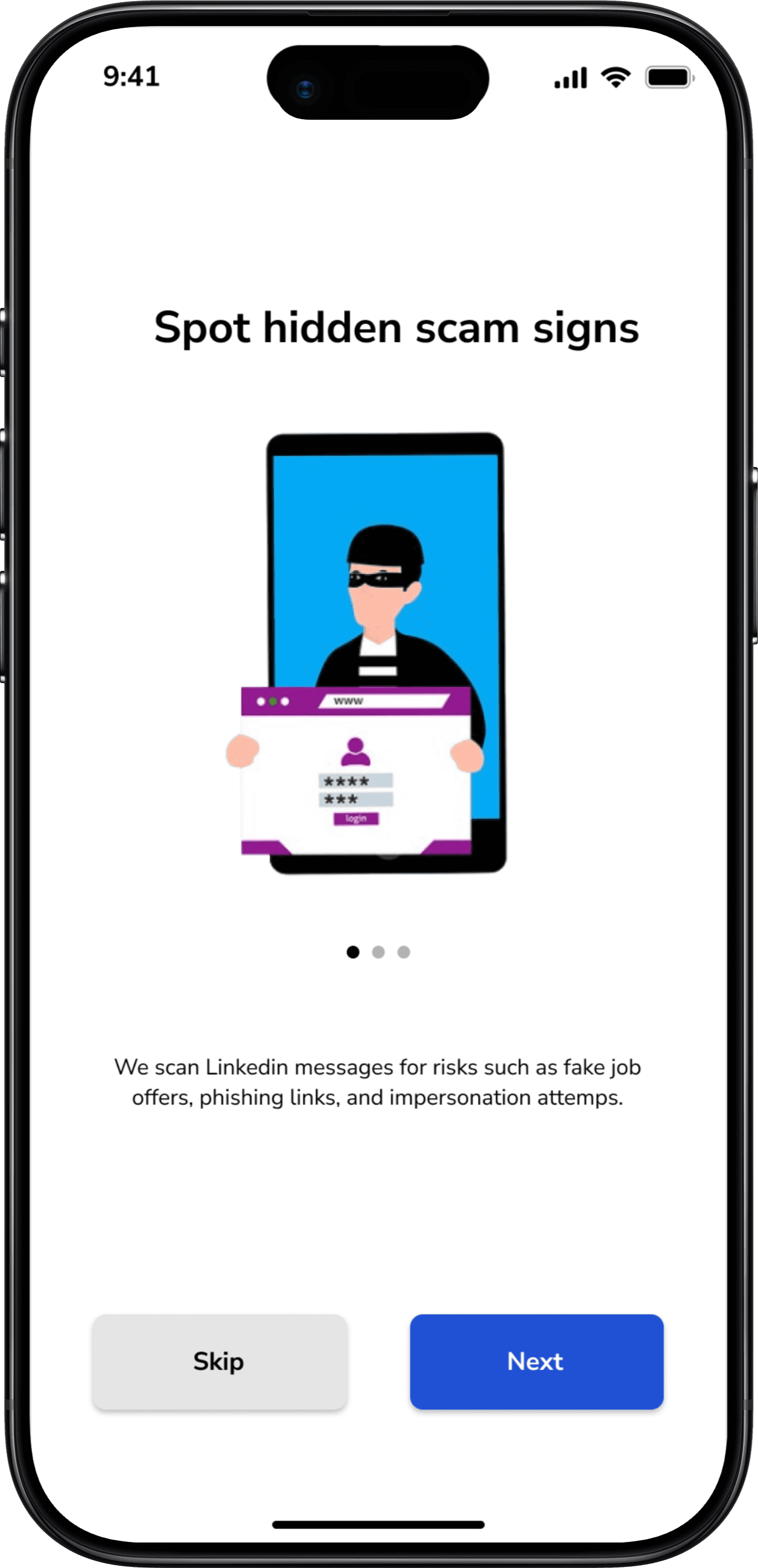
Stays out of the way — Once connected with Linkedin, it runs quietly in the background while users browse jobs and messages.
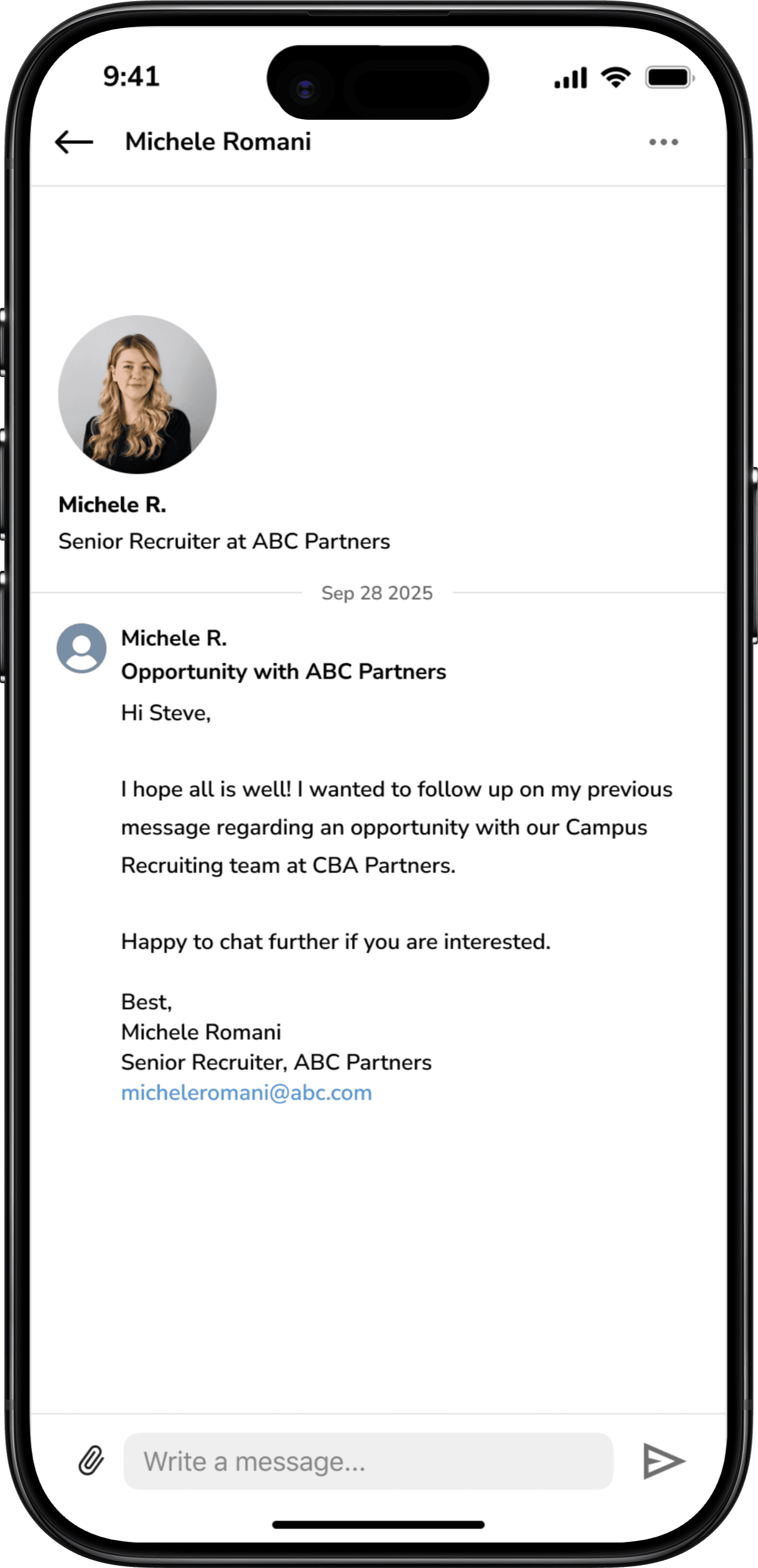
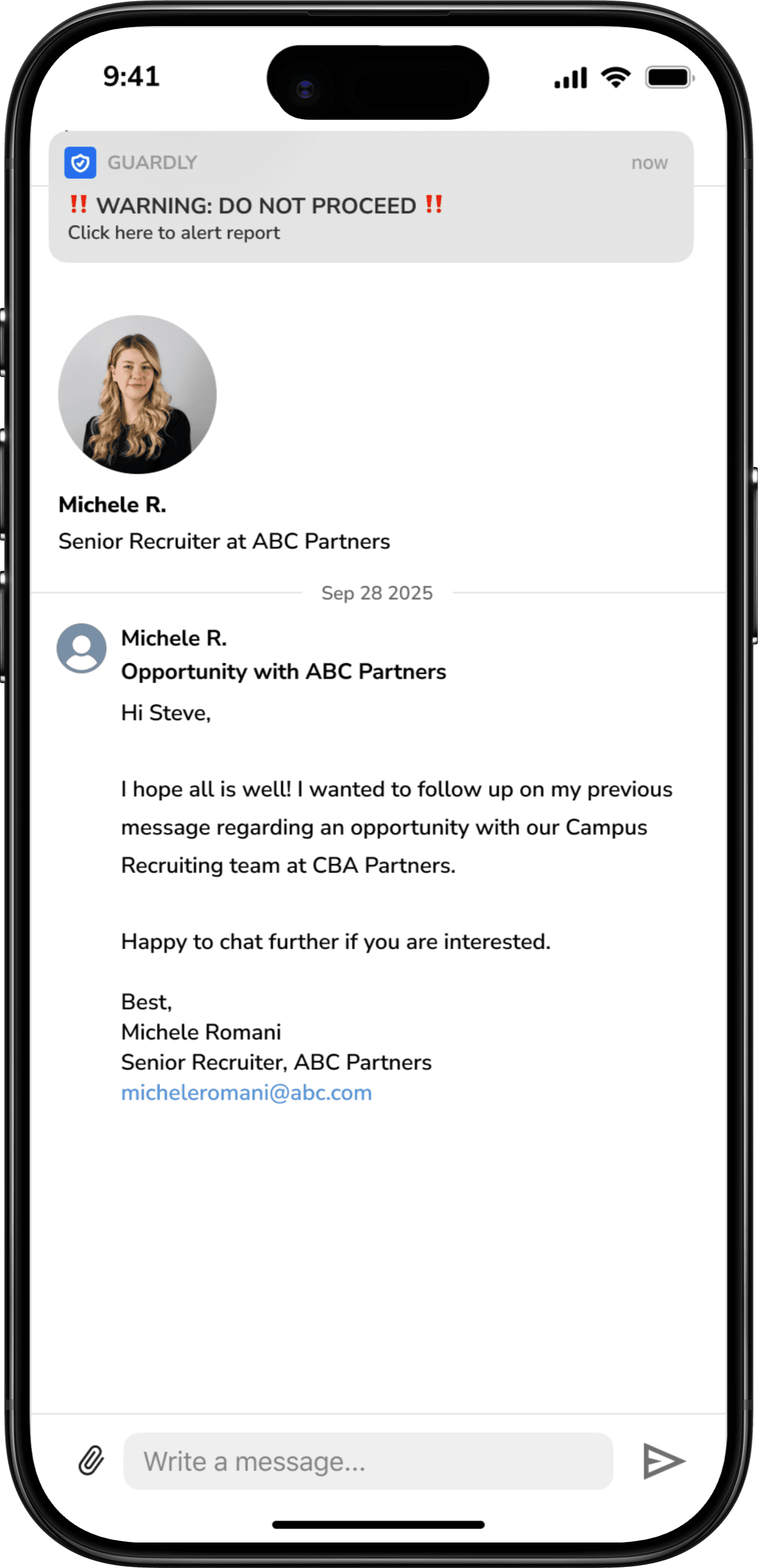
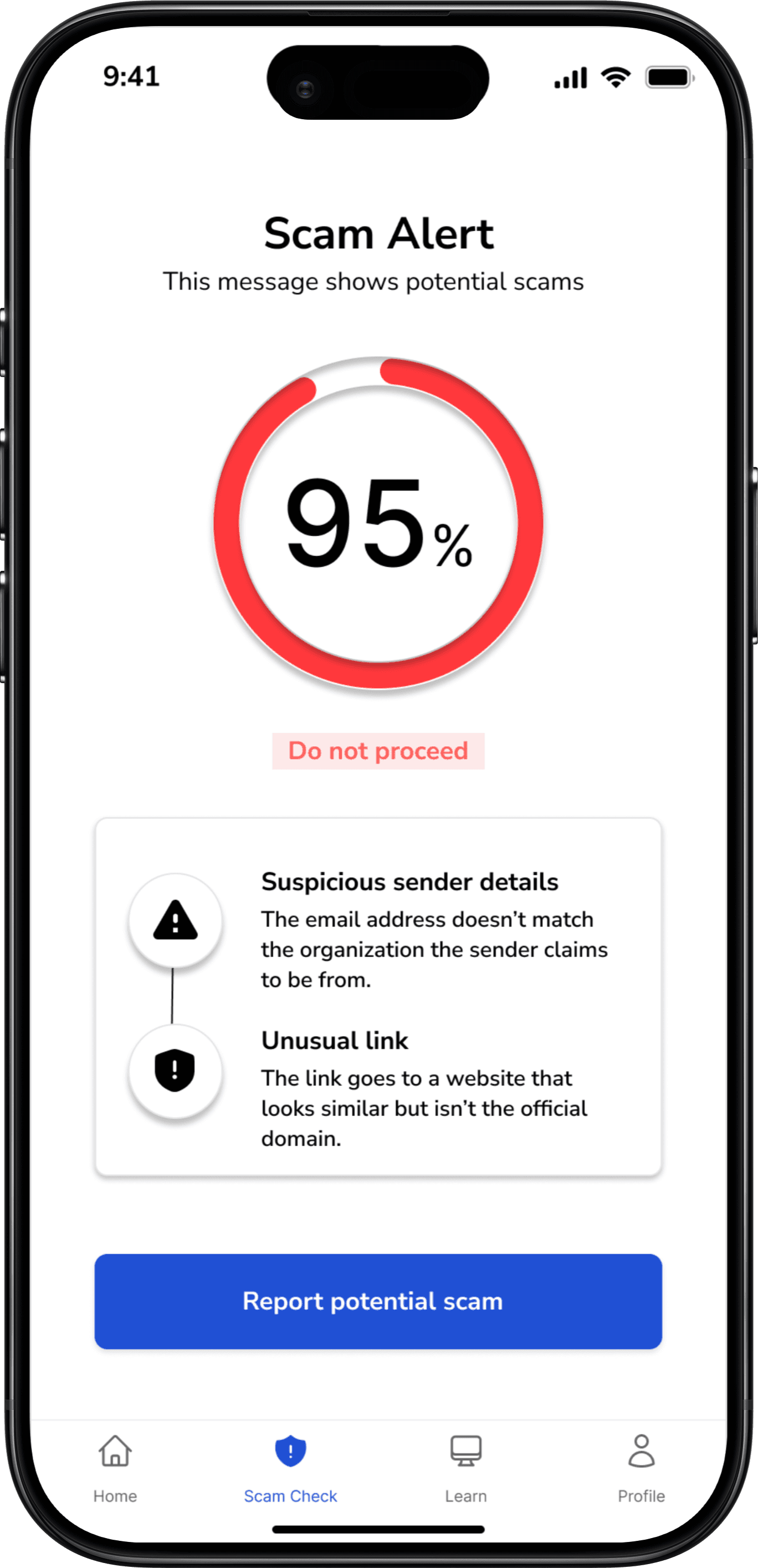
Steps in when risk is highest — surfacing calm warnings only when suspicious patterns appear.
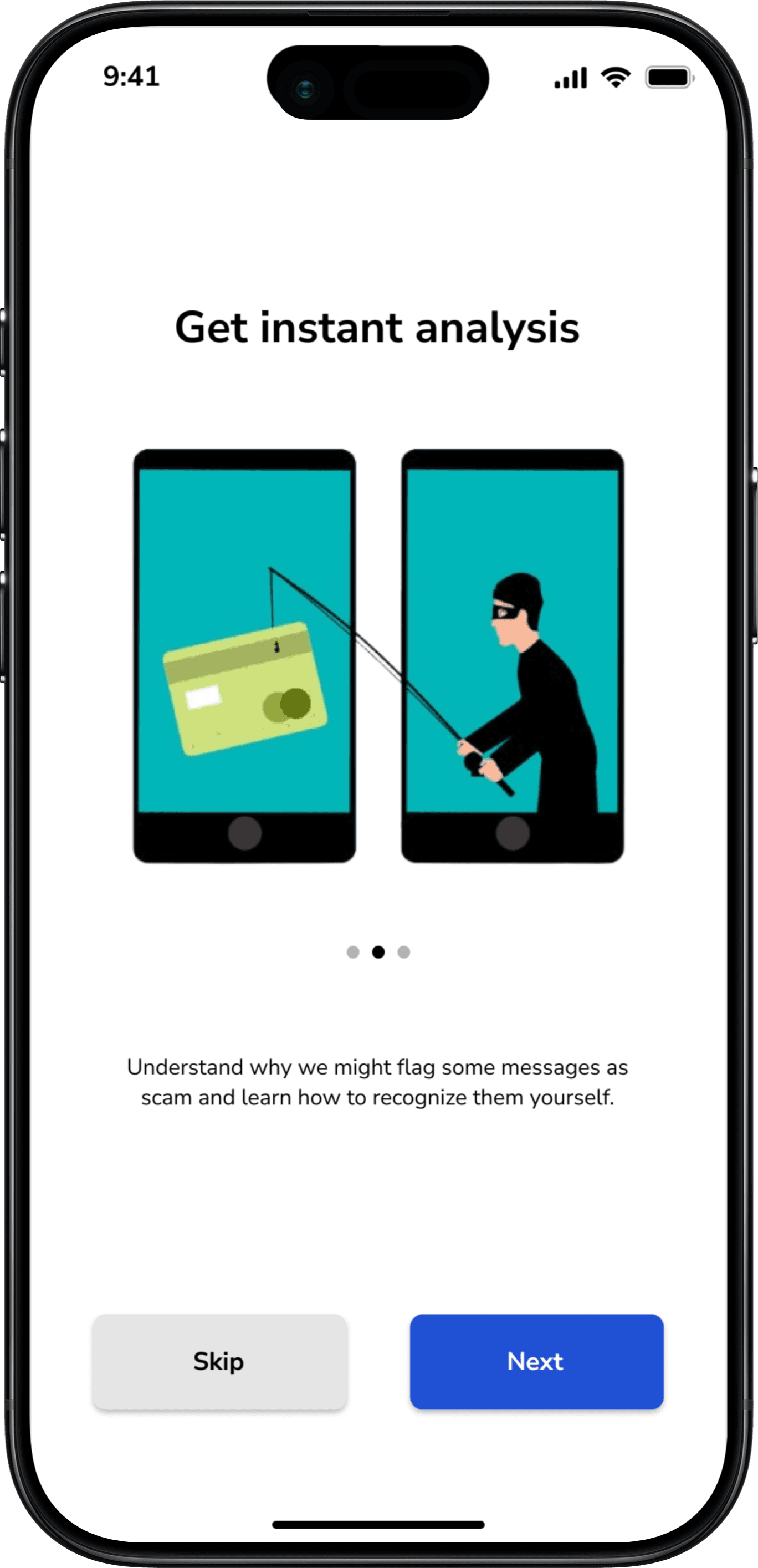
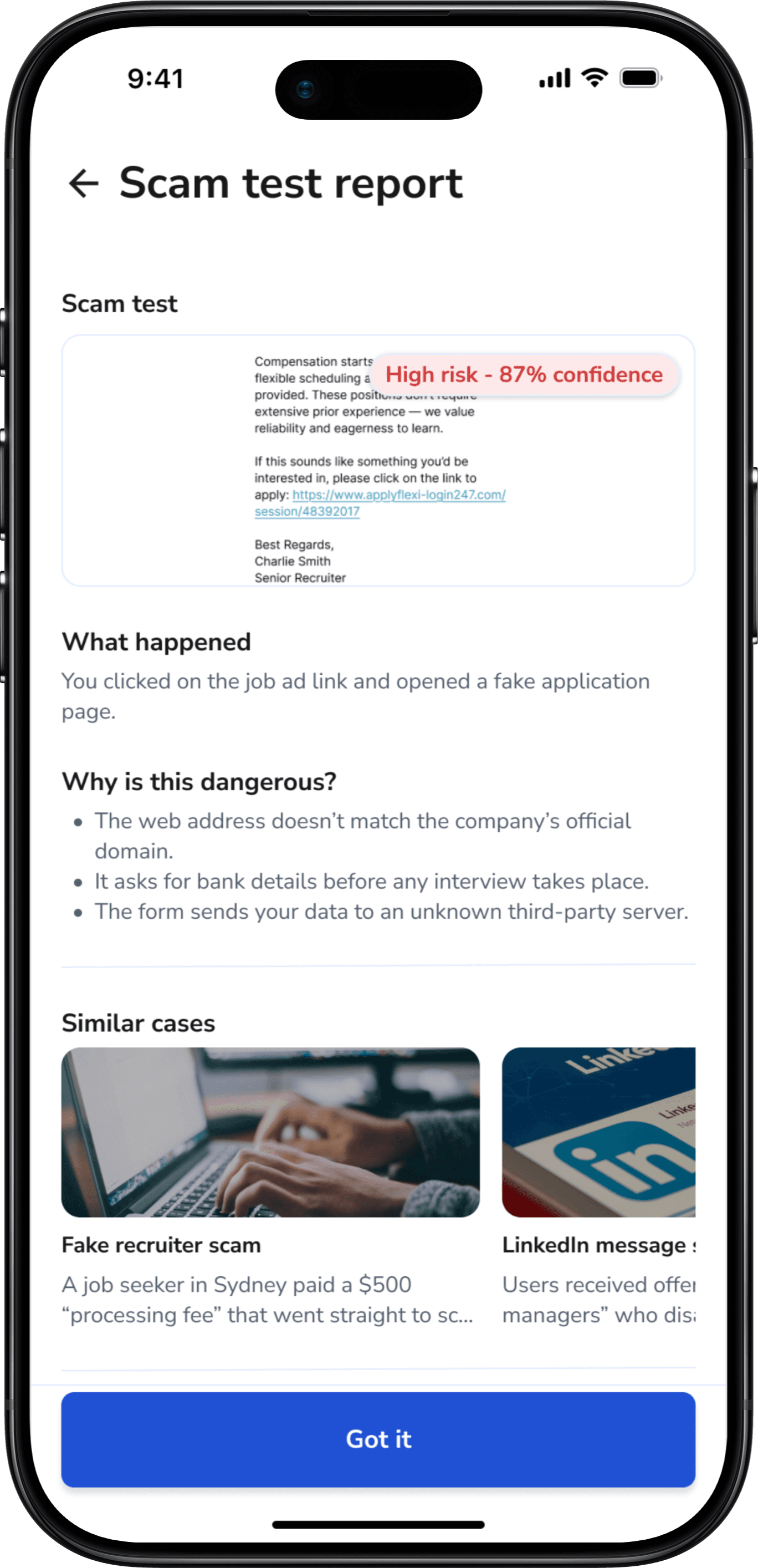
Helps users make sense of the risk — breaking down what feels off so users can decide what to do next with confidence.
Empowers users to take action — Report suspected scams and always closing the loop with clear follow-up, so reporting never feels pointless.
The Process
STARTING POINT
With 48 hours on the clock, we did a deep dive into the world of online scams — a space that turned out to be far more complex, emotional, and human than we expected.
While the brief broadly explored online safety, early research revealed many forms of digital harm. We chose to narrow our focus to job scams, where financial loss and emotional distress are often inflicted during the urgency, hope, and pressure of the job search.
DISCOVERING THE PROBLEM SPACE
In Australia alone, $13.5 million was lost to job scams in 2025, often during moments of urgency, hope, and emotional vulnerability.
Our research revealed that most existing scam prevention relies on policy, broad education, or platform-level signals such as labels and warnings. These interventions often live outside the moment of decision — appearing in classrooms, public campaigns, or after harm has already occurred — rather than when someone is about to click, reply, or share personal details.
We also found that heavy-handed regulation or platform bans can trigger resistance or feelings of censorship, especially when users don’t understand why something is being blocked. Even when warnings are present, they are often passive and non-actionable, leaving users unsure of what to do next.
In fast, emotionally charged online environments, urgency, optimism, and cognitive overload make it difficult for people to slow down and assess risk — precisely at the moments when caution matters most.
TALKING TO OUR USERS
Interviews with 25 young graduates revealed a pattern of overconfidence and vulnerability during scam encounters.
To dig deeper into these patterns, we conducted semi-structured interviews with 25 young graduates and early-career participants. We synthesised responses using an affinity diagram to cluster our findings.
[01] Overconfidence increases vulnerability
Many users, particularly younger job seekers, believed they were unlikely to fall for scams because they “grew up with the internet.” Despite this confidence, all interview participants are scam victims or knew someone who had been scammed.
[02] Intervention is often too late
Most existing solutions focus on education, policy, or content labeling, which typically occur before or after a risky interaction — not at the moment a user is deciding whether to engage. Cognitive overload and emotional decision-making mean critical thinking is often bypassed
[03] Job Scams are often the most legitimate looking
Unlike obvious scams, job-related scams often mirror real recruitment processes. Interviews, offer letters, and professional language build trust. The scam typically reveals itself during onboarding or payroll setup, when sensitive information is requested
[04] Scams are ignored, not reported
Reporting scams often felt pointless — once a report was submitted, users received no feedback or visibility into what happened next. Over time, this lack of transparency discouraged action, allowing scams to be ignored and repeated rather than actively addressed.
COMPETITOR ANALYSIS
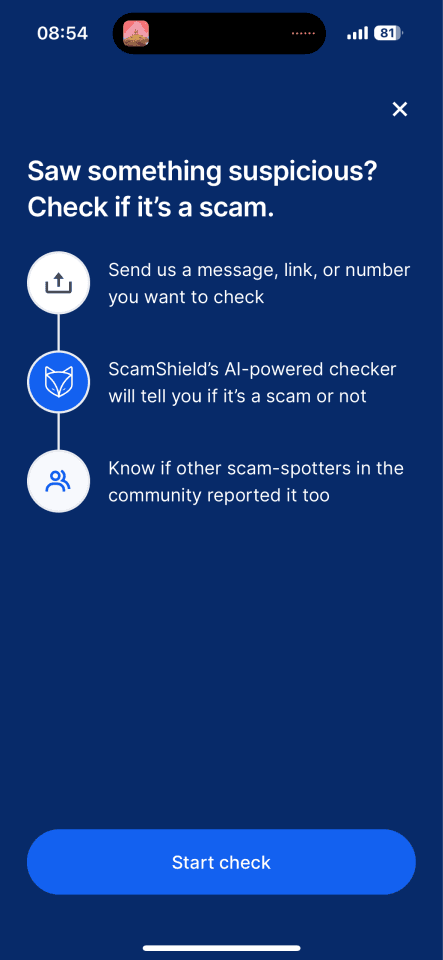
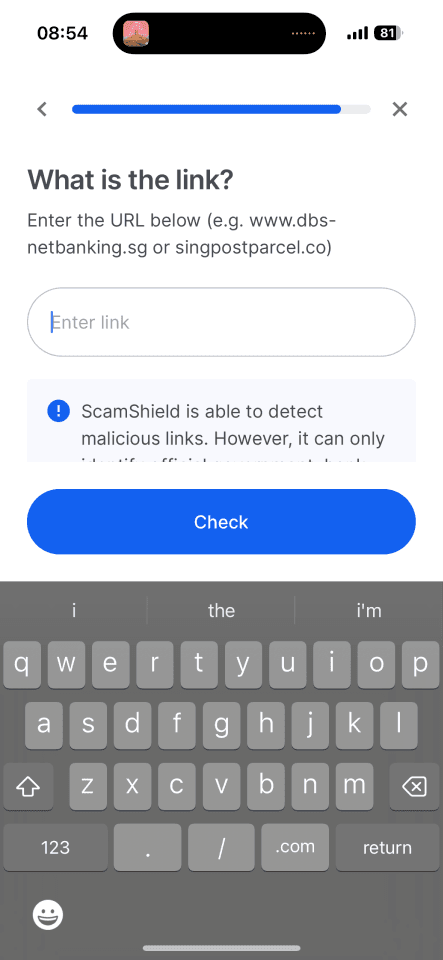
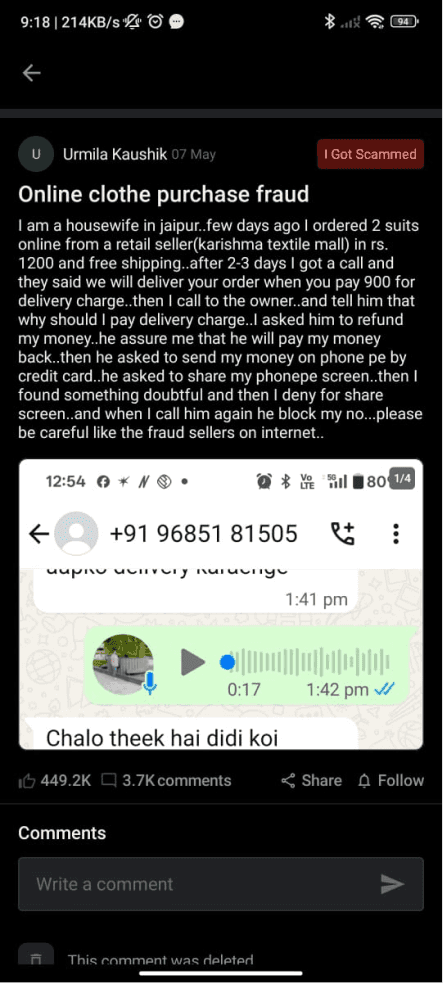
As our research progressed, we looked at existing scam protection tools such as Scam Shield and Truecaller. These products demonstrated how effective real-time intervention can be when scam detection is built directly into communication channels.
This made me think: “Why doesn’t this exist for online platforms - where scams are increasingly common?”
Scam Shield - Government backed
True Caller - Community based

Where it falls short
Reactive by design, protection often happens after exposure rather than before action
Only available for phone calls and SMS
Minimal learning and reflection, flags scams without helping users understand why or build long-term awareness
What it does well
Government-backed, signalling strong credibility for a safety product.
Grounded in real-world scam behaviour: Ability to check links, numbers and messages
Most protection happens automatically in the background, reducing the cognitive load required from users.
APPROACHING A SOLUTION
Creating just enough friction to stop scams, while building long-term awareness
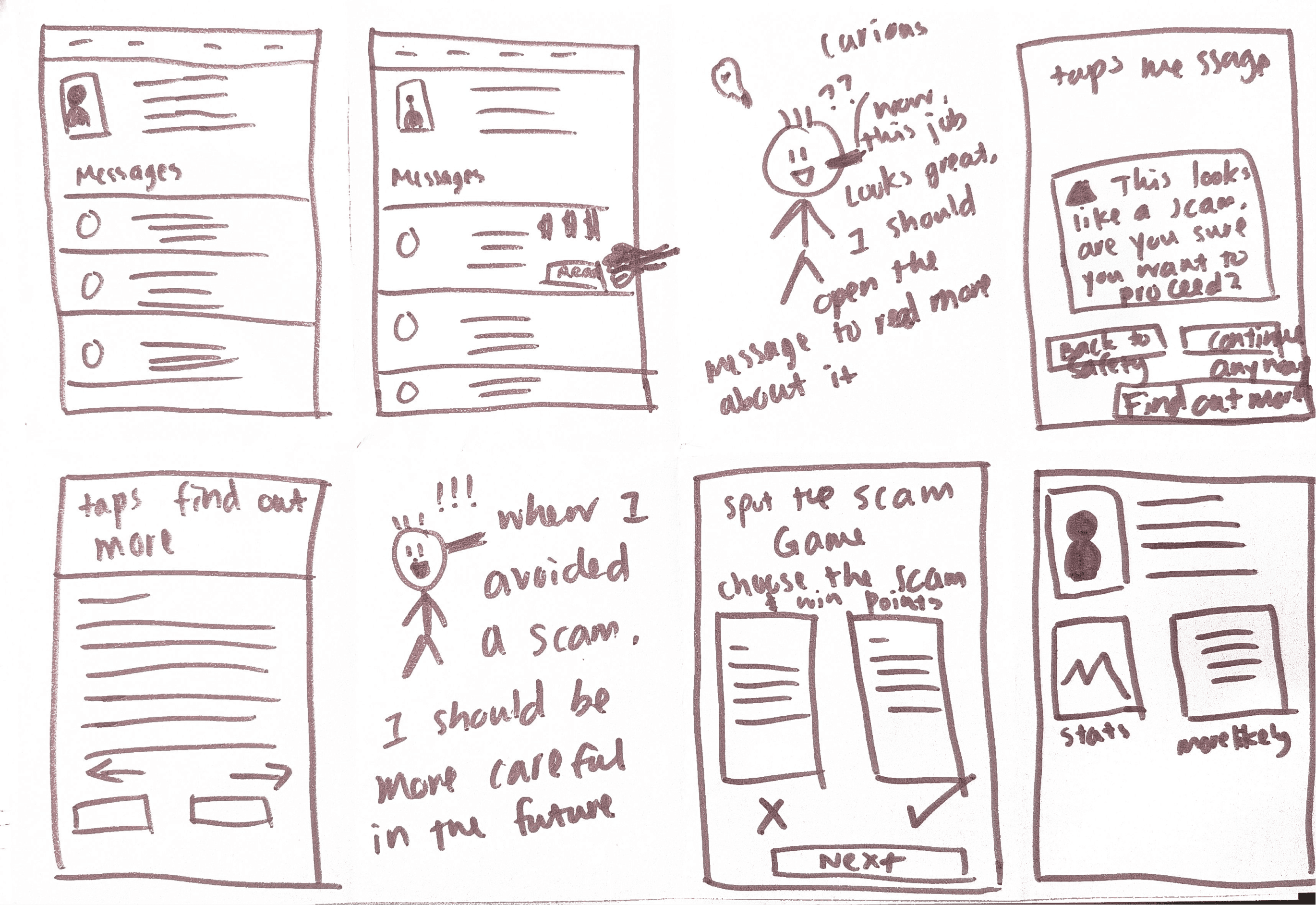
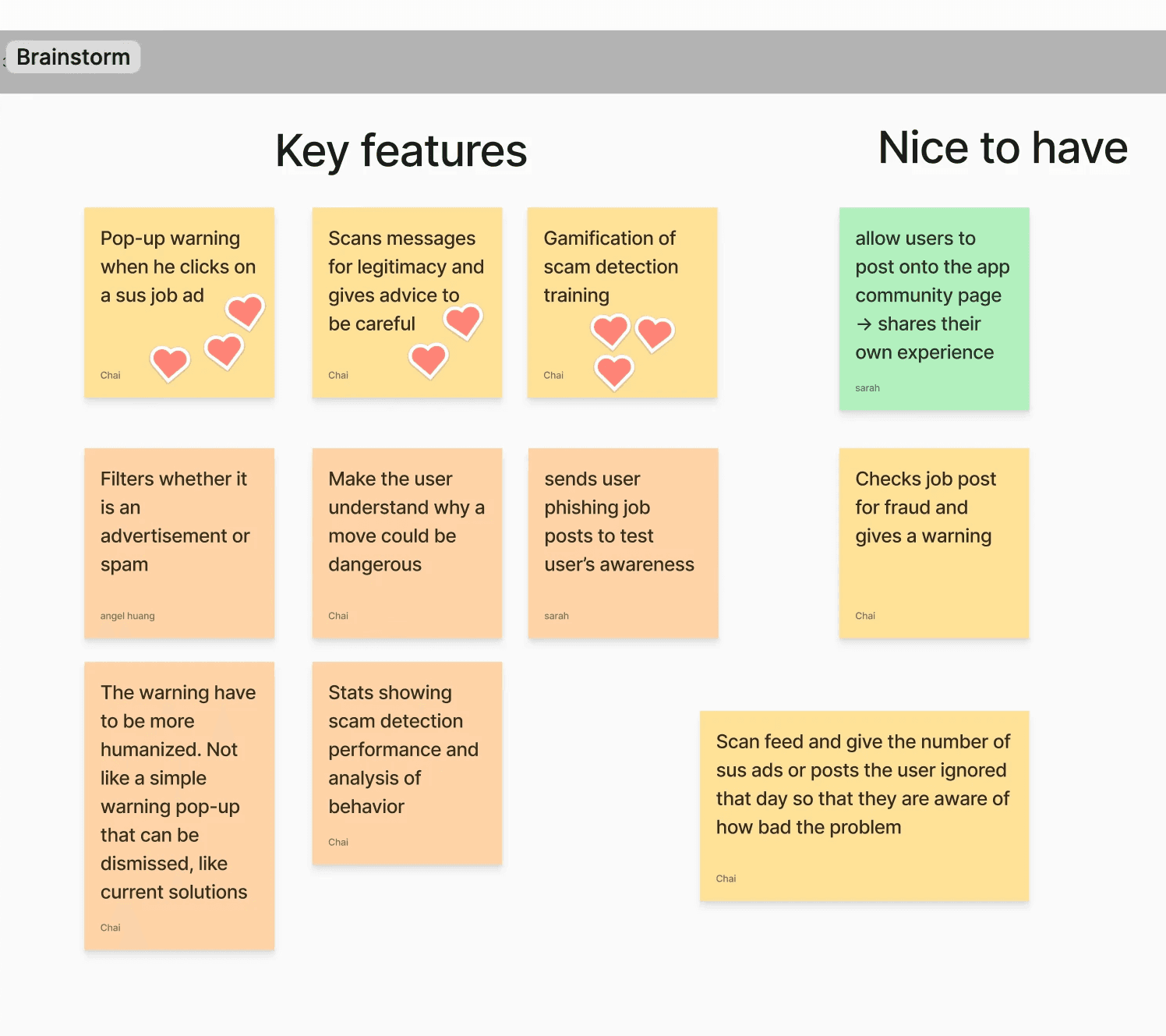
Under tight time constraints, we ran a Crazy 8s ideation session to rapidly explore solution directions. Using dot-voting, the team prioritised ideas that best aligned with our research insights and design principles. This allowed us to converge quickly on a focused, feasible solution.
Opportunities I identified
Timely intervention is key
We should introduce friction at the moment of decision, not reactively.
Education through context
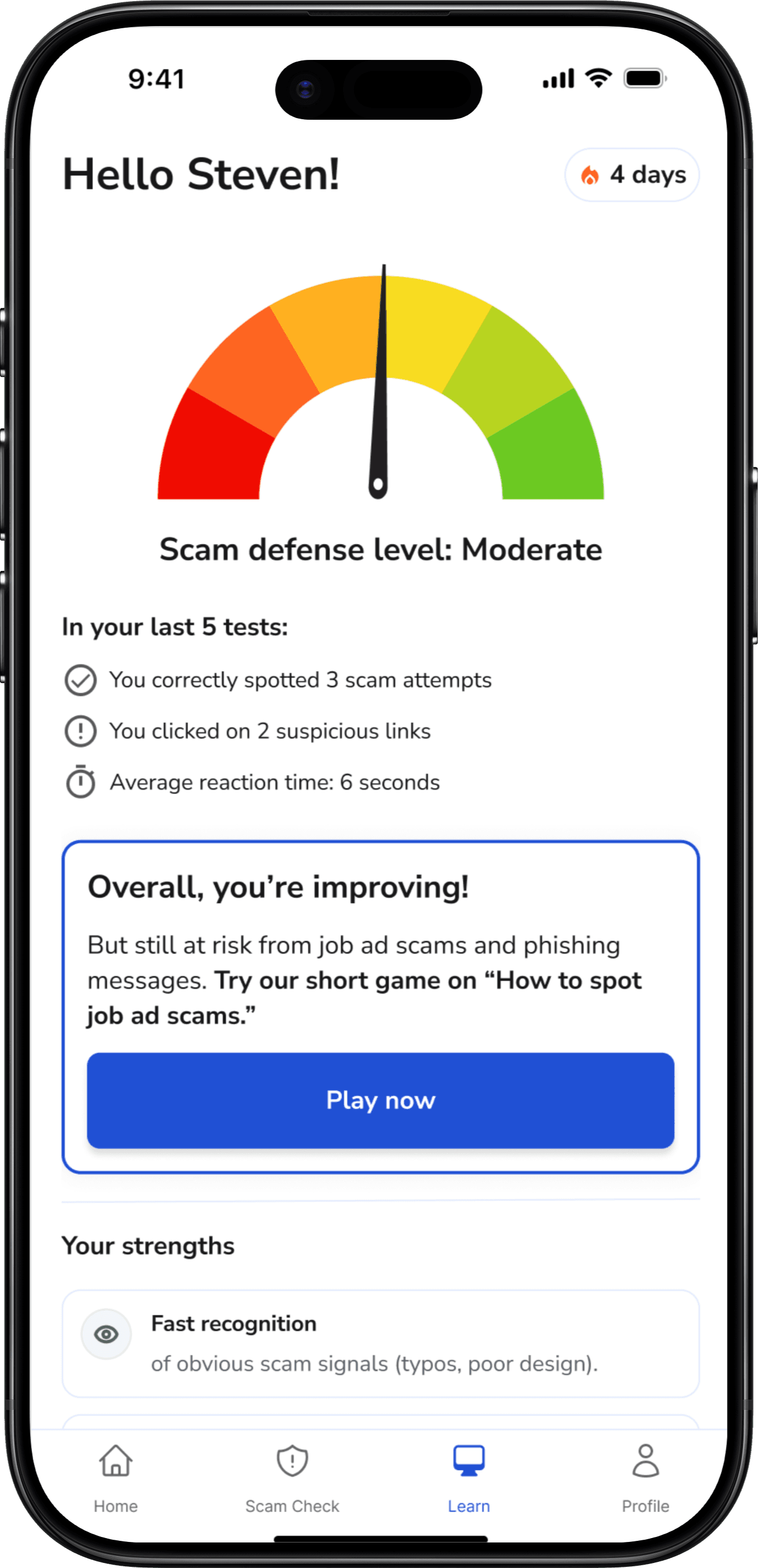
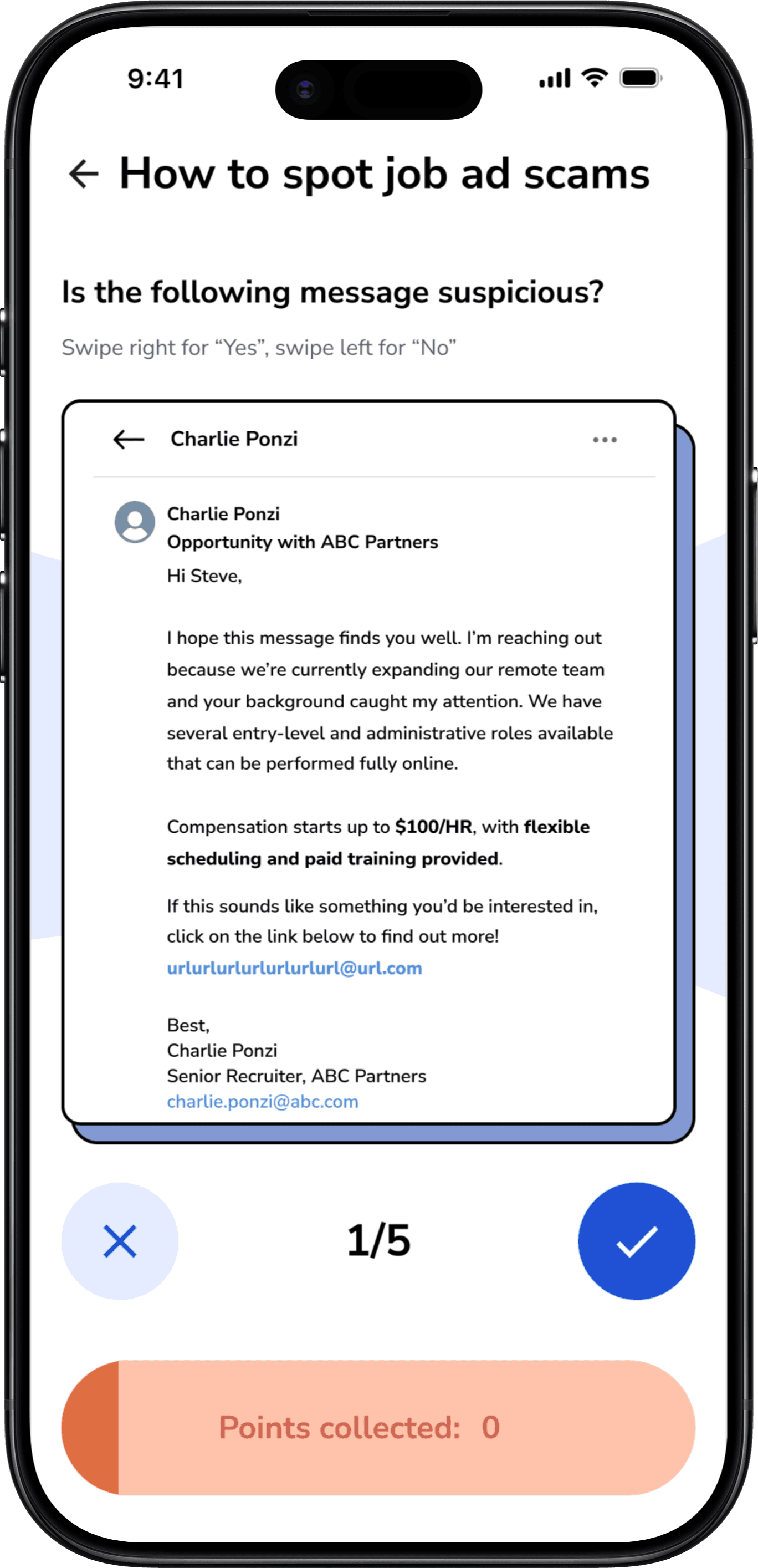
We should go beyond flagging scams by helping users understand why something is risky, building long-term scam awareness and confidence.
Expand to social media and online platforms
We should extend scam prevention into social media and online platforms where scams increasingly occur, but protections are limited.
REFRAMING THE HMW
Based on our research and interview, we reframed the design challengre to focus on when the scams occur, not just what they look like
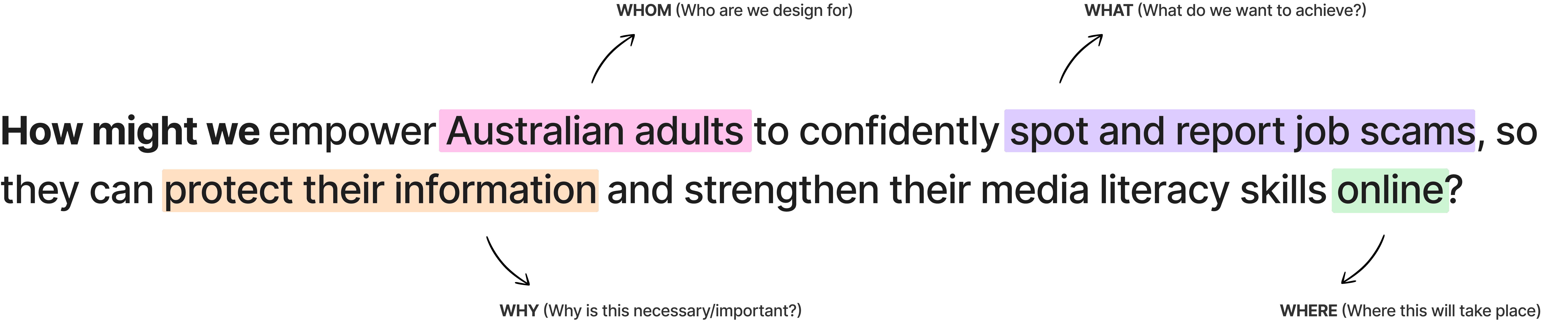
To ground this reframe, we created personas and mapped the user journey to better empathize with our users.
Full research available on our Figjam board
FINAL SOLUTION
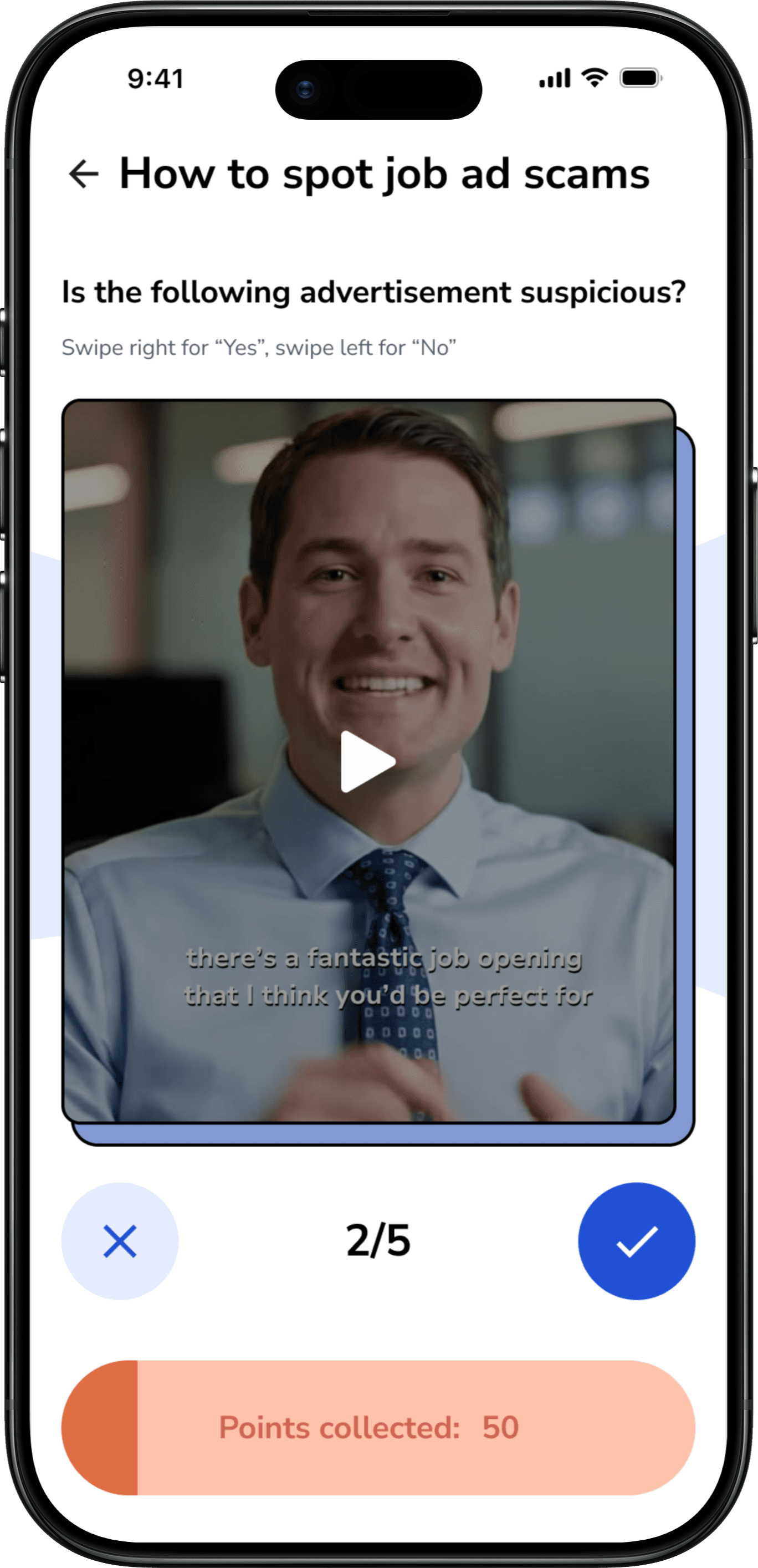
Job scams happens to more people than you think. Right now, no seamless tool helps job seekers verify opportunities as they browse. That gap leaves young Australians exposed — and it’s what our solution tackles.This made me think: “Why doesn’t this exist for online platforms - where scams are increasingly common?”
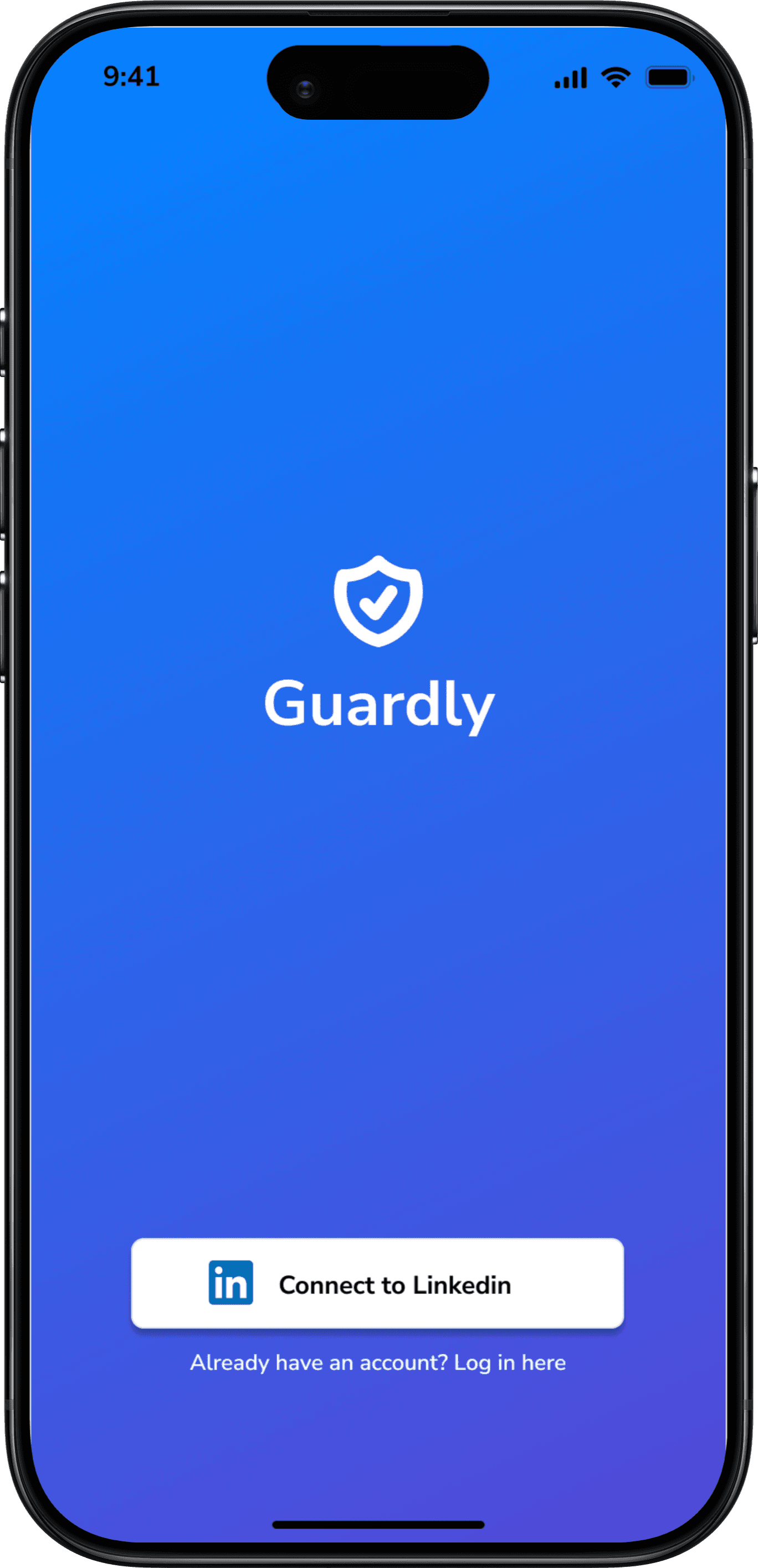
Trust building & Platform connection

Intentional friction at point of risk

Learning through real-world practice
Key learnings
How to make confident trade-offs without overthinking
Working fast (and sleep-deprived), I learned to synthesis data quickly, communicate decisively and prioritize under pressure
Teamwork really does make the dream work. With only 48 hours and a team of five, this designathon became a crash course in collaboration under pressure — and a reminder of how much I enjoy working collaboratively. This project reinforced my interest in designing systems that support users during emotionally vulnerable moments, where thoughtful UX decisions can make a real difference.
What I'd do with more time
Test with real job seeker - across different age group and level of digital literacy to validate the moment-based intervention
Friction without discouraging users - refine warning language and tone without causing fear or disengagement
Expand to advertisement scams - Extend the solution to address scams across border online platforms
COMPETITOR ANALYSIS
As our research progressed, we looked at existing scam protection tools such as Scam Shield and Truecaller. These products demonstrated how effective real-time intervention can be when scam detection is built directly into communication channels.
This made me think: “Why doesn’t this exist for online platforms - where scams are increasingly common?”
Scam Shield - Government backed
What it does well
Government-backed, signalling strong credibility for a safety product.
Grounded in real-world scam behaviour: Ability to check links, numbers and messages
Most protection happens automatically in the background, reducing the cognitive load required from users.
True Caller - Community based
Where it falls short
Reactive by design, protection often happens after exposure rather than before action
Only available for phone calls and SMS
Minimal learning and reflection, flags scams without helping users understand why or build long-term awareness
TALKING TO OUR USERS
Interviews with 25 young graduates revealed a pattern of overconfidence and vulnerability during scam encounters.
To dig deeper into these patterns, we conducted semi-structured interviews with 25 young graduates and early-career participants. We synthesised responses using an affinity diagram to cluster our findings.
[01] Overconfidence increases vulnerability
Many users, particularly younger job seekers, believed they were unlikely to fall for scams because they “grew up with the internet.” Despite this confidence, all interview participants are scam victims or knew someone who had been scammed.
[02] Intervention is often too late
Most existing solutions focus on education, policy, or content labeling, which typically occur before or after a risky interaction — not at the moment a user is deciding whether to engage. Cognitive overload and emotional decision-making mean critical thinking is often bypassed
[03] Job Scams are often the most legitimate looking
Unlike obvious scams, job-related scams often mirror real recruitment processes. Interviews, offer letters, and professional language build trust. The scam typically reveals itself during onboarding or payroll setup, when sensitive information is requested
[04] Scams are ignored, not reported
Reporting scams often felt pointless — once a report was submitted, users received no feedback or visibility into what happened next. Over time, this lack of transparency discouraged action, allowing scams to be ignored and repeated rather than actively addressed.
Opportunities I identified
Timely intervention is key
We should introduce friction at the moment of decision, not reactively.
Education through context
We should go beyond flagging scams by helping users understand why something is risky, building long-term scam awareness and confidence.
Expand to social media and online platforms
We should extend scam prevention into social media and online platforms where scams increasingly occur, but protections are limited.
APPROACHING A SOLUTION
Creating just enough friction to stop scams, while building long-term awareness
Under tight time constraints, we ran a Crazy 8s ideation session to rapidly explore solution directions. Using dot-voting, the team prioritised ideas that best aligned with our research insights and design principles. This allowed us to converge quickly on a focused, feasible solution.
FINAL SOLUTION
Job scams happens to more people than you think. Right now, no seamless tool helps job seekers verify opportunities as they browse. That gap leaves young Australians exposed — and it’s what our solution tackles.This made me think: “Why doesn’t this exist for online platforms - where scams are increasingly common?”
Trust building & Platform connection
Intentional friction at point of risk
Learning through real-world practice
REFRAMING THE HMW
Based on our research and interview, we reframed the design challengre to focus on when the scams occur, not just what they look like
To ground this reframe, we created personas and mapped the user journey to better empathize with our users.
Opportunities I identified
Timely intervention is key
We should introduce friction at the moment of decision, not reactively.
Education through context
We should go beyond flagging scams by helping users understand why something is risky, building long-term scam awareness and confidence.
Expand to social media and online platforms
We should extend scam prevention into social media and online platforms where scams increasingly occur, but protections are limited.
REFRAMING THE HMW
Based on our research and interview, we reframed the design challengre to focus on when the scams occur, not just what they look like
To ground this reframe, we created personas and mapped the user journey to better empathize with our users.
Full research available on our Figjam board
APPROACHING A SOLUTION
Creating just enough friction to stop scams, while building long-term awareness
Under tight time constraints, we ran a Crazy 8s ideation session to rapidly explore solution directions. Using dot-voting, the team prioritised ideas that best aligned with our research insights and design principles. This allowed us to converge quickly on a focused, feasible solution.
FINAL SOLUTION
Job scams happens to more people than you think. Right now, no seamless tool helps job seekers verify opportunities as they browse. That gap leaves young Australians exposed — and it’s what our solution tackles.This made me think: “Why doesn’t this exist for online platforms - where scams are increasingly common?”
Trust building & Platform connection
Intentional friction at point of risk
Learning through real-world practice
Key learnings
How to make confident trade-offs without overthinking
Working fast (and sleep-deprived), I learned to synthesis data quickly, communicate decisively and prioritize under pressure
Teamwork really does make the dream work. With only 48 hours and a team of five, this designathon became a crash course in collaboration under pressure — and a reminder of how much I enjoy working collaboratively. This project reinforced my interest in designing systems that support users during emotionally vulnerable moments, where thoughtful UX decisions can make a real difference.
What I'd do with more time
Test with real job seeker - across different age group and level of digital literacy to validate the moment-based intervention
Friction without discouraging users - refine warning language and tone without causing disengagement or panic
Expand to advertisement scams - Extend the solution to address scams across border online platforms
Guardly
A Scam-detection and education feature embedded within LinkedIn
INTRODUCTION
Guardly is a UX-led product developed during a 48-hour designathon, exploring how moment-based interventions can support job seekers at the point where scams are most likely to occur.
MY ROLE
I kept everyone aligned under tight time constraints by prioritising work and coordinating parallel workstreams. I contribute to the UX research and problem-definition phase, including framing the core challenge, sourcing supporting data, and shaping user interview questions.
I also owned the product narrative and final presentation to the judging panel, defining the story and communicating Guardly’s value and feasibility.
INTRODUCTION
Guardly is a UX-led product developed during a 48-hour designathon, exploring how moment-based interventions can support job seekers at the point where scams are most likely to occur.
[Project Scope]
Team of 5
[Role]
UX Designer - Product Manger
[Timeline]
48 hours designathon
View prototype
PROBLEM DISCOVERY
Job Scams look real and they catch people at their moment vunerable
Job scams no longer look suspicious. They look like real opportunities — complete with polished job listings, interviews, and official-looking offer letters. The danger often appears late in the process, during payroll onboarding, when job seekers are asked to share personal identification and bank details.
This makes scams especially effective during the job search, a time filled with urgency, hope, and emotional pressure. Many people are confident they won’t fall for scams until they find themselves caught in one.
This sparked a question -
“How might we empower users to confidently spot and report job scams so they can protect their personal information from online predators?”
PROBLEM DISCOVERY
Job Scams look real and they catch people at their moment vunerable
Job scams no longer look suspicious. They look like real opportunities — complete with polished job listings, interviews, and official-looking offer letters. The danger often appears late in the process, during payroll onboarding, when job seekers are asked to share personal identification and bank details.
This makes scams especially effective during the job search, a time filled with urgency, hope, and emotional pressure. Many people are confident they won’t fall for scams until they find themselves caught in one. This sparked a question -
“How might we empower users to confidently spot and report job scams so they can protect their personal information from online predators?”
Our Solution - Guardly
A moment-based scam detection and education experience for job seekers
Timely warning and clear guidance right when it matters most
Stays out of the way — Once connected with Linkedin, it runs quietly in the background while users browse jobs and messages.
Steps in when risk is highest — surfacing calm warnings only when suspicious patterns appear.
Helps users make sense of the risk — breaking down what feels off so users can decide what to do next with confidence.
Empowers users to take action — Report suspected scams and always closing the loop with clear follow-up, so reporting never feels pointless.
The Process
STARTING POINT
With 48 hours on the clock, we did a deep dive into the world of online scams — a space that turned out to be far more complex, emotional, and human than we expected.
While the brief broadly explored online safety, early research revealed many forms of digital harm. We chose to narrow our focus to job scams, where financial loss and emotional distress are often inflicted during the urgency, hope, and pressure of the job search.
DISCOVERING THE PROBLEM SPACE
In Australia alone, $13.5 million was lost to job scams in 2025, often during moments of urgency, hope, and emotional vulnerability.
Our research revealed that most existing scam prevention relies on policy, broad education, or platform-level signals such as labels and warnings. These interventions often live outside the moment of decision — appearing in classrooms, public campaigns, or after harm has already occurred — rather than when someone is about to click, reply, or share personal details.
We also found that heavy-handed regulation or platform bans can trigger resistance or feelings of censorship, especially when users don’t understand why something is being blocked. Even when warnings are present, they are often passive and non-actionable, leaving users unsure of what to do next.
In fast, emotionally charged online environments, urgency, optimism, and cognitive overload make it difficult for people to slow down and assess risk — precisely at the moments when caution matters most.
TALKING TO OUR USERS
Interviews with 25 young graduates revealed a pattern of overconfidence and vulnerability during scam encounters.
To dig deeper into these patterns, we conducted semi-structured interviews with 25 young graduates and early-career participants. We synthesised responses using an affinity diagram to cluster our findings.
[01] Overconfidence increases vulnerability
Many users, particularly younger job seekers, believed they were unlikely to fall for scams because they “grew up with the internet.” Despite this confidence, all interview participants are scam victims or knew someone who had been scammed.
[02] Intervention is often too late
Most existing solutions focus on education, policy, or content labeling, which typically occur before or after a risky interaction — not at the moment a user is deciding whether to engage. Cognitive overload and emotional decision-making mean critical thinking is often bypassed
[03] Job Scams are often the most legitimate looking
Unlike obvious scams, job-related scams often mirror real recruitment processes. Interviews, offer letters, and professional language build trust. The scam typically reveals itself during onboarding or payroll setup, when sensitive information is requested
[04] Scams are ignored, not reported
Reporting scams often felt pointless — once a report was submitted, users received no feedback or visibility into what happened next. Over time, this lack of transparency discouraged action, allowing scams to be ignored and repeated rather than actively addressed.
COMPETITOR ANALYSIS
As our research progressed, we looked at existing scam protection tools such as Scam Shield and Truecaller. These products demonstrated how effective real-time intervention can be when scam detection is built directly into communication channels.
This made me think: “Why doesn’t this exist for online platforms - where scams are increasingly common?”
Scam Shield - Government backed
True Caller - Community based
Where it falls short
Reactive by design, protection often happens after exposure rather than before action
Only available for phone calls and SMS
Minimal learning and reflection, flags scams without helping users understand why or build long-term awareness
What it does well
Government-backed, signalling strong credibility for a safety product.
Grounded in real-world scam behaviour: Ability to check links, numbers and messages
Most protection happens automatically in the background, reducing the cognitive load required from users.
APPROACHING A SOLUTION
Creating just enough friction to stop scams, while building long-term awareness
Under tight time constraints, we ran a Crazy 8s ideation session to rapidly explore solution directions. Using dot-voting, the team prioritised ideas that best aligned with our research insights and design principles. This allowed us to converge quickly on a focused, feasible solution.
Opportunities I identified
Timely intervention is key
We should introduce friction at the moment of decision, not reactively.
Education through context
We should go beyond flagging scams by helping users understand why something is risky, building long-term scam awareness and confidence.
Expand to social media and online platforms
We should extend scam prevention into social media and online platforms where scams increasingly occur, but protections are limited.
REFRAMING THE HMW
Based on our research and interview, we reframed the design challengre to focus on when the scams occur, not just what they look like
To ground this reframe, we created personas and mapped the user journey to better empathize with our users.
Full research available on our Figjam board
FINAL SOLUTION
Job scams happens to more people than you think. Right now, no seamless tool helps job seekers verify opportunities as they browse. That gap leaves young Australians exposed — and it’s what our solution tackles.This made me think: “Why doesn’t this exist for online platforms - where scams are increasingly common?”
Trust building & Platform connection
Intentional friction at point of risk
Learning through real-world practice
Key learnings
How to make confident trade-offs without overthinking
Working fast (and sleep-deprived), I learned to synthesis data quickly, communicate decisively and prioritize under pressure
Teamwork really does make the dream work. With only 48 hours and a team of five, this designathon became a crash course in collaboration under pressure — and a reminder of how much I enjoy working collaboratively. This project reinforced my interest in designing systems that support users during emotionally vulnerable moments, where thoughtful UX decisions can make a real difference.
What I'd do with more time
Test with real job seeker - across different age group and level of digital literacy to validate the moment-based intervention
Friction without discouraging users - refine warning language and tone without causing fear or disengagement
Expand to advertisement scams - Extend the solution to address scams across border online platforms
COMPETITOR ANALYSIS
As our research progressed, we looked at existing scam protection tools such as Scam Shield and Truecaller. These products demonstrated how effective real-time intervention can be when scam detection is built directly into communication channels.
This made me think: “Why doesn’t this exist for online platforms - where scams are increasingly common?”
Scam Shield - Government backed
What it does well
Government-backed, signalling strong credibility for a safety product.
Grounded in real-world scam behaviour: Ability to check links, numbers and messages
Most protection happens automatically in the background, reducing the cognitive load required from users.
True Caller - Community based
Where it falls short
Reactive by design, protection often happens after exposure rather than before action
Only available for phone calls and SMS
Minimal learning and reflection, flags scams without helping users understand why or build long-term awareness
TALKING TO OUR USERS
Interviews with 25 young graduates revealed a pattern of overconfidence and vulnerability during scam encounters.
To dig deeper into these patterns, we conducted semi-structured interviews with 25 young graduates and early-career participants. We synthesised responses using an affinity diagram to cluster our findings.
[01] Overconfidence increases vulnerability
Many users, particularly younger job seekers, believed they were unlikely to fall for scams because they “grew up with the internet.” Despite this confidence, all interview participants are scam victims or knew someone who had been scammed.
[02] Intervention is often too late
Most existing solutions focus on education, policy, or content labeling, which typically occur before or after a risky interaction — not at the moment a user is deciding whether to engage. Cognitive overload and emotional decision-making mean critical thinking is often bypassed
[03] Job Scams are often the most legitimate looking
Unlike obvious scams, job-related scams often mirror real recruitment processes. Interviews, offer letters, and professional language build trust. The scam typically reveals itself during onboarding or payroll setup, when sensitive information is requested
[04] Scams are ignored, not reported
Reporting scams often felt pointless — once a report was submitted, users received no feedback or visibility into what happened next. Over time, this lack of transparency discouraged action, allowing scams to be ignored and repeated rather than actively addressed.
Opportunities I identified
Timely intervention is key
We should introduce friction at the moment of decision, not reactively.
Education through context
We should go beyond flagging scams by helping users understand why something is risky, building long-term scam awareness and confidence.
Expand to social media and online platforms
We should extend scam prevention into social media and online platforms where scams increasingly occur, but protections are limited.
APPROACHING A SOLUTION
Creating just enough friction to stop scams, while building long-term awareness
Under tight time constraints, we ran a Crazy 8s ideation session to rapidly explore solution directions. Using dot-voting, the team prioritised ideas that best aligned with our research insights and design principles. This allowed us to converge quickly on a focused, feasible solution.
FINAL SOLUTION
Job scams happens to more people than you think. Right now, no seamless tool helps job seekers verify opportunities as they browse. That gap leaves young Australians exposed — and it’s what our solution tackles.This made me think: “Why doesn’t this exist for online platforms - where scams are increasingly common?”
Trust building & Platform connection
Intentional friction at point of risk
Learning through real-world practice
REFRAMING THE HMW
Based on our research and interview, we reframed the design challengre to focus on when the scams occur, not just what they look like
To ground this reframe, we created personas and mapped the user journey to better empathize with our users.
Opportunities I identified
Timely intervention is key
We should introduce friction at the moment of decision, not reactively.
Education through context
We should go beyond flagging scams by helping users understand why something is risky, building long-term scam awareness and confidence.
Expand to social media and online platforms
We should extend scam prevention into social media and online platforms where scams increasingly occur, but protections are limited.
REFRAMING THE HMW
Based on our research and interview, we reframed the design challengre to focus on when the scams occur, not just what they look like
To ground this reframe, we created personas and mapped the user journey to better empathize with our users.
Full research available on our Figjam board
APPROACHING A SOLUTION
Creating just enough friction to stop scams, while building long-term awareness
Under tight time constraints, we ran a Crazy 8s ideation session to rapidly explore solution directions. Using dot-voting, the team prioritised ideas that best aligned with our research insights and design principles. This allowed us to converge quickly on a focused, feasible solution.
FINAL SOLUTION
Job scams happens to more people than you think. Right now, no seamless tool helps job seekers verify opportunities as they browse. That gap leaves young Australians exposed — and it’s what our solution tackles.This made me think: “Why doesn’t this exist for online platforms - where scams are increasingly common?”
Trust building & Platform connection
Intentional friction at point of risk
Learning through real-world practice
Key learnings
How to make confident trade-offs without overthinking
Working fast (and sleep-deprived), I learned to synthesis data quickly, communicate decisively and prioritize under pressure
Teamwork really does make the dream work. With only 48 hours and a team of five, this designathon became a crash course in collaboration under pressure — and a reminder of how much I enjoy working collaboratively. This project reinforced my interest in designing systems that support users during emotionally vulnerable moments, where thoughtful UX decisions can make a real difference.
What I'd do with more time
Test with real job seeker - across different age group and level of digital literacy to validate the moment-based intervention
Friction without discouraging users - refine warning language and tone without causing disengagement or panic
Expand to advertisement scams - Extend the solution to address scams across border online platforms
Guardly
A Scam-detection and education feature embedded within LinkedIn
INTRODUCTION
Guardly is a UX-led product developed during a 48-hour designathon, exploring how moment-based interventions can support job seekers at the point where scams are most likely to occur.
MY ROLE
I kept everyone aligned under tight time constraints by prioritising work and coordinating parallel workstreams. I contribute to the UX research and problem-definition phase, including framing the core challenge, sourcing supporting data, and shaping user interview questions.
I also owned the product narrative and final presentation to the judging panel, defining the story and communicating Guardly’s value and feasibility.
INTRODUCTION
Guardly is a UX-led product developed during a 48-hour designathon, exploring how moment-based interventions can support job seekers at the point where scams are most likely to occur.
[Project Scope]
Team of 5
[Role]
UX Designer - Product Manger
[Timeline]
48 hours designathon
View prototype
PROBLEM DISCOVERY
Job Scams look real and they catch people at their moment vunerable
Job scams no longer look suspicious. They look like real opportunities — complete with polished job listings, interviews, and official-looking offer letters. The danger often appears late in the process, during payroll onboarding, when job seekers are asked to share personal identification and bank details.
This makes scams especially effective during the job search, a time filled with urgency, hope, and emotional pressure. Many people are confident they won’t fall for scams until they find themselves caught in one.
This sparked a question -
“How might we empower users to confidently spot and report job scams so they can protect their personal information from online predators?”
PROBLEM DISCOVERY
Job Scams look real and they catch people at their moment vunerable
Job scams no longer look suspicious. They look like real opportunities — complete with polished job listings, interviews, and official-looking offer letters. The danger often appears late in the process, during payroll onboarding, when job seekers are asked to share personal identification and bank details.
This makes scams especially effective during the job search, a time filled with urgency, hope, and emotional pressure. Many people are confident they won’t fall for scams until they find themselves caught in one. This sparked a question -
“How might we empower users to confidently spot and report job scams so they can protect their personal information from online predators?”
Our Solution - Guardly
A moment-based scam detection and education experience for job seekers
Timely warning and clear guidance right when it matters most
Stays out of the way — Once connected with Linkedin, it runs quietly in the background while users browse jobs and messages.
Steps in when risk is highest — surfacing calm warnings only when suspicious patterns appear.
Helps users make sense of the risk — breaking down what feels off so users can decide what to do next with confidence.
Empowers users to take action — Report suspected scams and always closing the loop with clear follow-up, so reporting never feels pointless.
The Process
STARTING POINT
With 48 hours on the clock, we did a deep dive into the world of online scams — a space that turned out to be far more complex, emotional, and human than we expected.
While the brief broadly explored online safety, early research revealed many forms of digital harm. We chose to narrow our focus to job scams, where financial loss and emotional distress are often inflicted during the urgency, hope, and pressure of the job search.
DISCOVERING THE PROBLEM SPACE
In Australia alone, $13.5 million was lost to job scams in 2025, often during moments of urgency, hope, and emotional vulnerability.
Our research revealed that most existing scam prevention relies on policy, broad education, or platform-level signals such as labels and warnings. These interventions often live outside the moment of decision — appearing in classrooms, public campaigns, or after harm has already occurred — rather than when someone is about to click, reply, or share personal details.
We also found that heavy-handed regulation or platform bans can trigger resistance or feelings of censorship, especially when users don’t understand why something is being blocked. Even when warnings are present, they are often passive and non-actionable, leaving users unsure of what to do next.
In fast, emotionally charged online environments, urgency, optimism, and cognitive overload make it difficult for people to slow down and assess risk — precisely at the moments when caution matters most.
TALKING TO OUR USERS
Interviews with 25 young graduates revealed a pattern of overconfidence and vulnerability during scam encounters.
To dig deeper into these patterns, we conducted semi-structured interviews with 25 young graduates and early-career participants. We synthesised responses using an affinity diagram to cluster our findings.
[01] Overconfidence increases vulnerability
Many users, particularly younger job seekers, believed they were unlikely to fall for scams because they “grew up with the internet.” Despite this confidence, all interview participants are scam victims or knew someone who had been scammed.
[02] Intervention is often too late
Most existing solutions focus on education, policy, or content labeling, which typically occur before or after a risky interaction — not at the moment a user is deciding whether to engage. Cognitive overload and emotional decision-making mean critical thinking is often bypassed
[03] Job Scams are often the most legitimate looking
Unlike obvious scams, job-related scams often mirror real recruitment processes. Interviews, offer letters, and professional language build trust. The scam typically reveals itself during onboarding or payroll setup, when sensitive information is requested
[04] Scams are ignored, not reported
Reporting scams often felt pointless — once a report was submitted, users received no feedback or visibility into what happened next. Over time, this lack of transparency discouraged action, allowing scams to be ignored and repeated rather than actively addressed.
COMPETITOR ANALYSIS
As our research progressed, we looked at existing scam protection tools such as Scam Shield and Truecaller. These products demonstrated how effective real-time intervention can be when scam detection is built directly into communication channels.
This made me think: “Why doesn’t this exist for online platforms - where scams are increasingly common?”
Scam Shield - Government backed
True Caller - Community based
Where it falls short
Reactive by design, protection often happens after exposure rather than before action
Only available for phone calls and SMS
Minimal learning and reflection, flags scams without helping users understand why or build long-term awareness
What it does well
Government-backed, signalling strong credibility for a safety product.
Grounded in real-world scam behaviour: Ability to check links, numbers and messages
Most protection happens automatically in the background, reducing the cognitive load required from users.
APPROACHING A SOLUTION
Creating just enough friction to stop scams, while building long-term awareness
Under tight time constraints, we ran a Crazy 8s ideation session to rapidly explore solution directions. Using dot-voting, the team prioritised ideas that best aligned with our research insights and design principles. This allowed us to converge quickly on a focused, feasible solution.
Opportunities I identified
Timely intervention is key
We should introduce friction at the moment of decision, not reactively.
Education through context
We should go beyond flagging scams by helping users understand why something is risky, building long-term scam awareness and confidence.
Expand to social media and online platforms
We should extend scam prevention into social media and online platforms where scams increasingly occur, but protections are limited.
REFRAMING THE HMW
Based on our research and interview, we reframed the design challengre to focus on when the scams occur, not just what they look like
To ground this reframe, we created personas and mapped the user journey to better empathize with our users.
Full research available on our Figjam board
FINAL SOLUTION
Job scams happens to more people than you think. Right now, no seamless tool helps job seekers verify opportunities as they browse. That gap leaves young Australians exposed — and it’s what our solution tackles.This made me think: “Why doesn’t this exist for online platforms - where scams are increasingly common?”
Trust building & Platform connection
Intentional friction at point of risk
Learning through real-world practice
Key learnings
How to make confident trade-offs without overthinking
Working fast (and sleep-deprived), I learned to synthesis data quickly, communicate decisively and prioritize under pressure
Teamwork really does make the dream work. With only 48 hours and a team of five, this designathon became a crash course in collaboration under pressure — and a reminder of how much I enjoy working collaboratively. This project reinforced my interest in designing systems that support users during emotionally vulnerable moments, where thoughtful UX decisions can make a real difference.
What I'd do with more time
Test with real job seeker - across different age group and level of digital literacy to validate the moment-based intervention
Friction without discouraging users - refine warning language and tone without causing fear or disengagement
Expand to advertisement scams - Extend the solution to address scams across border online platforms
COMPETITOR ANALYSIS
As our research progressed, we looked at existing scam protection tools such as Scam Shield and Truecaller. These products demonstrated how effective real-time intervention can be when scam detection is built directly into communication channels.
This made me think: “Why doesn’t this exist for online platforms - where scams are increasingly common?”
Scam Shield - Government backed
What it does well
Government-backed, signalling strong credibility for a safety product.
Grounded in real-world scam behaviour: Ability to check links, numbers and messages
Most protection happens automatically in the background, reducing the cognitive load required from users.
True Caller - Community based
Where it falls short
Reactive by design, protection often happens after exposure rather than before action
Only available for phone calls and SMS
Minimal learning and reflection, flags scams without helping users understand why or build long-term awareness
TALKING TO OUR USERS
Interviews with 25 young graduates revealed a pattern of overconfidence and vulnerability during scam encounters.
To dig deeper into these patterns, we conducted semi-structured interviews with 25 young graduates and early-career participants. We synthesised responses using an affinity diagram to cluster our findings.
[01] Overconfidence increases vulnerability
Many users, particularly younger job seekers, believed they were unlikely to fall for scams because they “grew up with the internet.” Despite this confidence, all interview participants are scam victims or knew someone who had been scammed.
[02] Intervention is often too late
Most existing solutions focus on education, policy, or content labeling, which typically occur before or after a risky interaction — not at the moment a user is deciding whether to engage. Cognitive overload and emotional decision-making mean critical thinking is often bypassed
[03] Job Scams are often the most legitimate looking
Unlike obvious scams, job-related scams often mirror real recruitment processes. Interviews, offer letters, and professional language build trust. The scam typically reveals itself during onboarding or payroll setup, when sensitive information is requested
[04] Scams are ignored, not reported
Reporting scams often felt pointless — once a report was submitted, users received no feedback or visibility into what happened next. Over time, this lack of transparency discouraged action, allowing scams to be ignored and repeated rather than actively addressed.
Opportunities I identified
Timely intervention is key
We should introduce friction at the moment of decision, not reactively.
Education through context
We should go beyond flagging scams by helping users understand why something is risky, building long-term scam awareness and confidence.
Expand to social media and online platforms
We should extend scam prevention into social media and online platforms where scams increasingly occur, but protections are limited.
APPROACHING A SOLUTION
Creating just enough friction to stop scams, while building long-term awareness
Under tight time constraints, we ran a Crazy 8s ideation session to rapidly explore solution directions. Using dot-voting, the team prioritised ideas that best aligned with our research insights and design principles. This allowed us to converge quickly on a focused, feasible solution.
FINAL SOLUTION
Job scams happens to more people than you think. Right now, no seamless tool helps job seekers verify opportunities as they browse. That gap leaves young Australians exposed — and it’s what our solution tackles.This made me think: “Why doesn’t this exist for online platforms - where scams are increasingly common?”
Trust building & Platform connection
Intentional friction at point of risk
Learning through real-world practice
REFRAMING THE HMW
Based on our research and interview, we reframed the design challengre to focus on when the scams occur, not just what they look like
To ground this reframe, we created personas and mapped the user journey to better empathize with our users.
Opportunities I identified
Timely intervention is key
We should introduce friction at the moment of decision, not reactively.
Education through context
We should go beyond flagging scams by helping users understand why something is risky, building long-term scam awareness and confidence.
Expand to social media and online platforms
We should extend scam prevention into social media and online platforms where scams increasingly occur, but protections are limited.
REFRAMING THE HMW
Based on our research and interview, we reframed the design challengre to focus on when the scams occur, not just what they look like
To ground this reframe, we created personas and mapped the user journey to better empathize with our users.
Full research available on our Figjam board
APPROACHING A SOLUTION
Creating just enough friction to stop scams, while building long-term awareness
Under tight time constraints, we ran a Crazy 8s ideation session to rapidly explore solution directions. Using dot-voting, the team prioritised ideas that best aligned with our research insights and design principles. This allowed us to converge quickly on a focused, feasible solution.
FINAL SOLUTION
Job scams happens to more people than you think. Right now, no seamless tool helps job seekers verify opportunities as they browse. That gap leaves young Australians exposed — and it’s what our solution tackles.This made me think: “Why doesn’t this exist for online platforms - where scams are increasingly common?”
Trust building & Platform connection
Intentional friction at point of risk
Learning through real-world practice
Key learnings
How to make confident trade-offs without overthinking
Working fast (and sleep-deprived), I learned to synthesis data quickly, communicate decisively and prioritize under pressure
Teamwork really does make the dream work. With only 48 hours and a team of five, this designathon became a crash course in collaboration under pressure — and a reminder of how much I enjoy working collaboratively. This project reinforced my interest in designing systems that support users during emotionally vulnerable moments, where thoughtful UX decisions can make a real difference.