Cup n' Go
A service design product for university campus tackling single-use waste through supporting behaviour change
INTRODUCTION
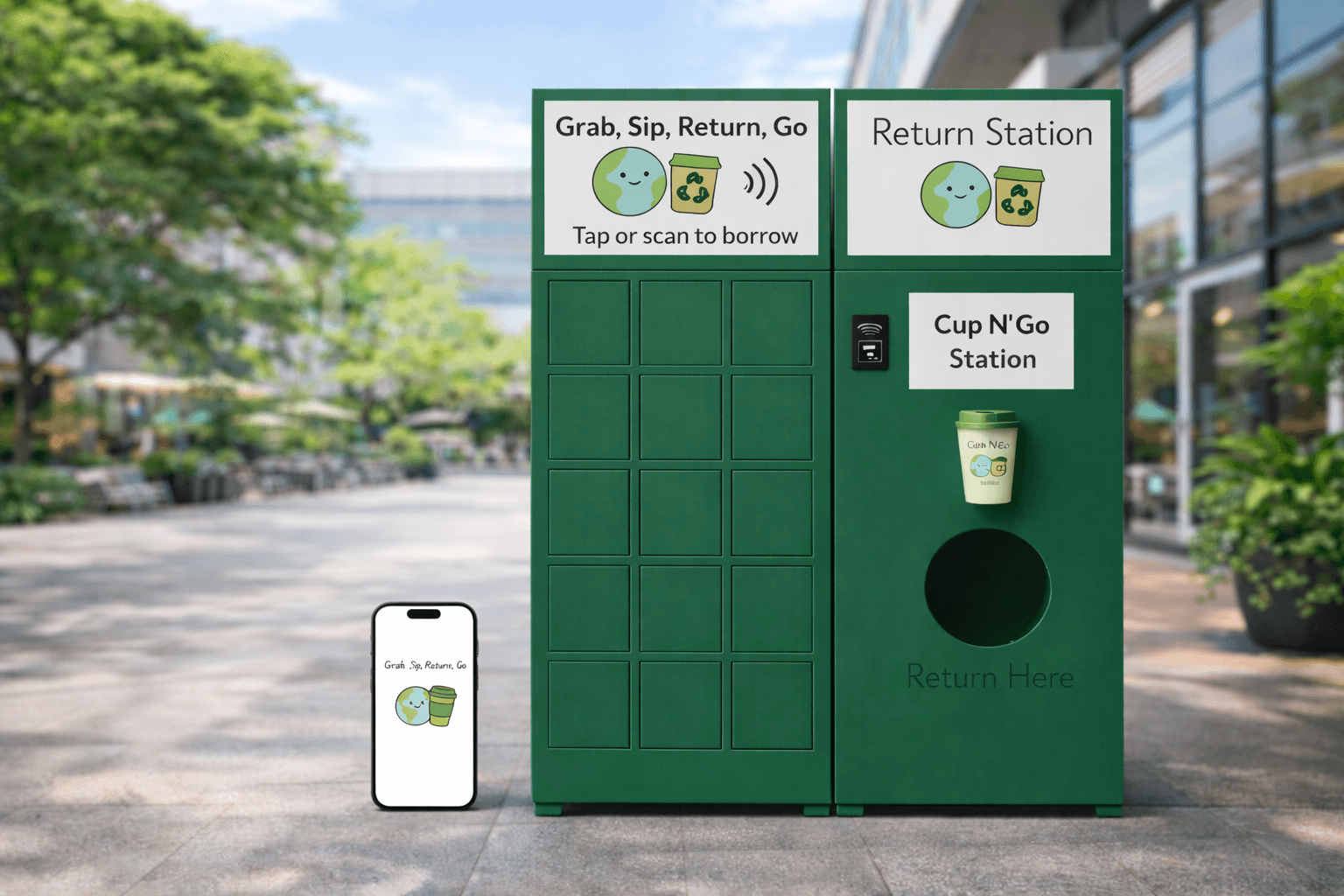
Cup n' Go is a service design product exploring how behaviour change can reduce single-use cup waste. It reframes the problem from awareness to systems, shaped by user interviews that revealed why good intentions alone don’t lead to reuse.
MY ROLE
I led the UX design work within a cross-disciplinary team of five, collaborating with teammates from computer science backgrounds.
Conducted user research and interviews, contributing insights that informed the overall problem framing
Led ideation and concept development, proposing the shared cup and locker system that became the final direction
Planned and facilitated user testing using low-fidelity prototypes to validate behaviour change and system feasibility
Led the synthesis of user feedback, consolidating findings across multiple testing rounds into clear insights and design decisions
INTRODUCTION
Guardly is a UX-led product developed during a 48-hour designathon, exploring how moment-based interventions can support job seekers at the point where scams are most likely to occur.
[Project Scope]
Team of 5
[Role]
Project led, UX Design
[Tools]
Paper & cardboard prototype
Figma
[Timeline]
10 weeks
View prototype
PROBLEM DISCOVERY
Most students want to be sustainable — but their daily routines make it hard to act that way
On campus, sustainability awareness is high. Many students carry reusable water bottles and understand the environmental impact of single-use plastics. Yet takeaway coffee and bubble tea cups remain one of the largest sources of daily waste at the University of Sydney.
Through conversations with students at campus cafés and food courts, a clear pattern emerged: the issue wasn’t motivation, but practicality. Students commute with heavy backpacks, walk long distances between buildings, and juggle busy schedules. Carrying — and cleaning — an extra reusable cup felt impractical.
Single-use cups, by contrast, were effortless, familiar, and easy to forget once discarded. This sparked a question:
"How might we design a campus wide system at the University of Sydney that makes reusable drink containers more convenient, hygienic, and rewarding than single-use cups?
PROBLEM DISCOVERY
Most students want to be sustainable — but their daily routines make it hard to act that way
On campus, sustainability awareness is high. Many students carry reusable water bottles and understand the environmental impact of single-use plastics. Yet takeaway coffee and bubble tea cups remain one of the largest sources of daily waste at the University of Sydney.
Through conversations with students at campus cafés and food courts, a clear pattern emerged: the issue wasn’t motivation, but practicality. Students commute with heavy backpacks, walk long distances between buildings, and juggle busy schedules. Carrying — and cleaning — an extra reusable cup felt impractical.
Single-use cups, by contrast, were effortless, familiar, and easy to forget once discarded. This sparked a question:
“How might we empower users to confidently spot and report job scams so they can protect their personal information from online predators?”
Our Solution - Resilient Lismore
A reusable cup locker system designed to integrate reuse into everyday routines
WITHOUT requiring students to own, carry, or remember to bring a reusable cup
How does it work?
Borrow — Students borrow a reusable cup from a self-service Cup n Go locker at participating campus cafés.
Use — The cup can be used for coffee or bubble tea and kept for up to 7 days, fitting naturally into students’ routines.
Return — Cups are returned to any Cup n Go return locker across campus, then collected, professionally washed, and redistributed back into the system.
The Process
STARTING POINT - UNDERSTANDING THE WHY
Single-use cup waste is a widely recognised sustainability issue, yet behaviour at scale has barely changed. I began this project by trying to understand why —
Why disposable takeaway cups remain so embedded in daily routines despite years of awareness campaigns, incentives, and media attention?
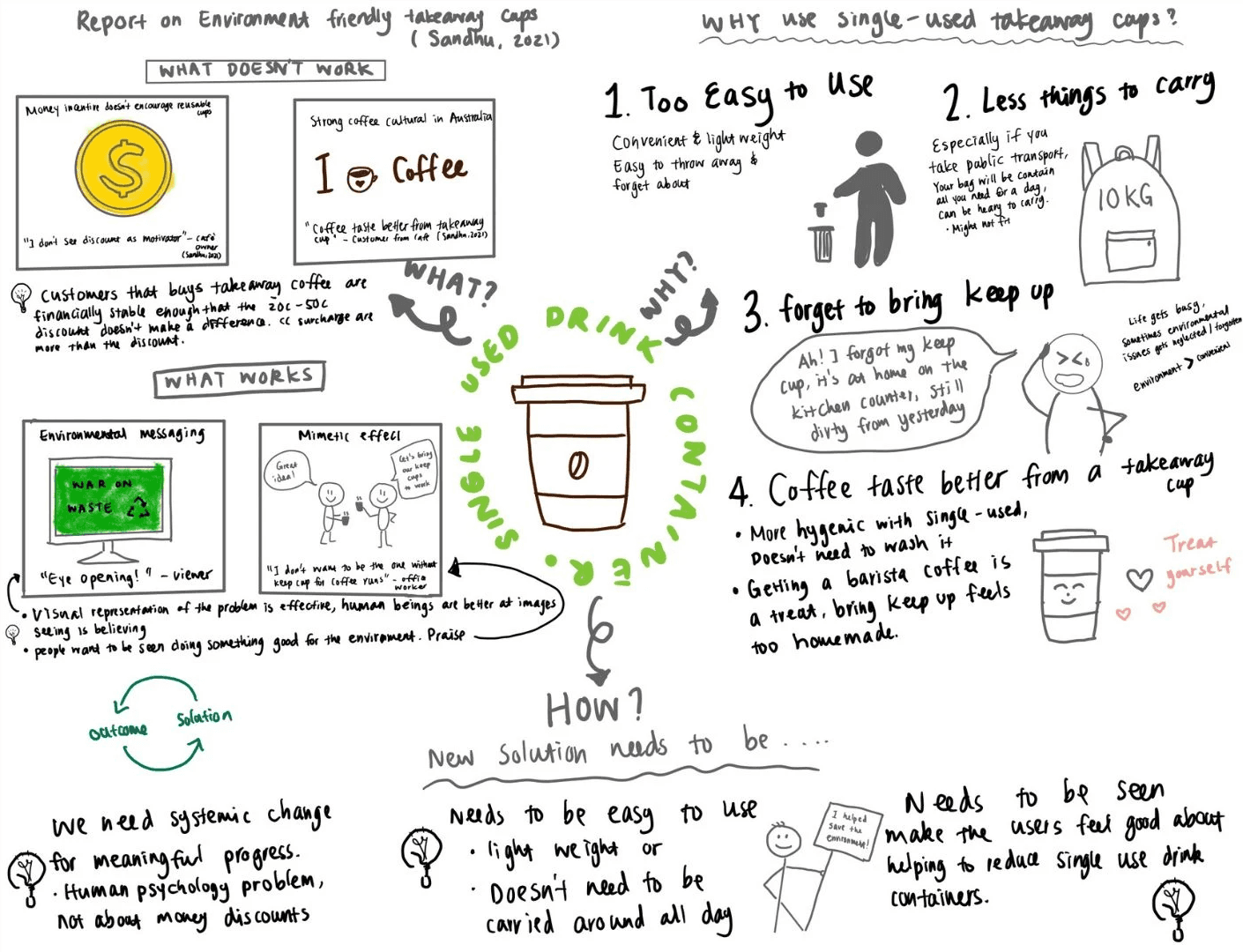
Hand-drawn sketch note capturing early research insights and hypotheses
What doesn't work
Financial incentives
Small discounts for reusable cups were shown to have no impact on daily decisions — a finding supported by both academic research (Sandhu et al., 2021) and UN sustainability frameworks.
Ignoring emotional association
Takeaway drinks are often linked to indulgence, and better taste. For many users, the takeaway coffee cups feel more “treat-like” and less homemade
What works
Mimetic behaviour
Seeing others reuse cups and visibly participate in sustainable behaviour encourages adoption more effectively than abstract messaging.
Awareness campaigns (short term)
Documentaries, public installations, and sustainability messaging are effective but it’s short term, and the effect fades quickly
What doesn't work
Financial incentives
Small discounts for reusable cups were shown to have no impact on daily decisions — a finding supported by both academic research (Sandhu et al., 2021) and UN sustainability frameworks.
Ignoring emotional association
Takeaway drinks are often linked to indulgence, and better taste. For many users, the takeaway coffee cups feel more “treat-like” and less homemade
What works
Mimetic behaviour
Seeing others reuse cups and visibly participate in sustainable behaviour encourages adoption more effectively than abstract messaging.
Awareness campaigns (short term)
Documentaries, public installations, and sustainability messaging are effective but it’s short term, and the effect fades quickly
TALKING TO OUR USERS
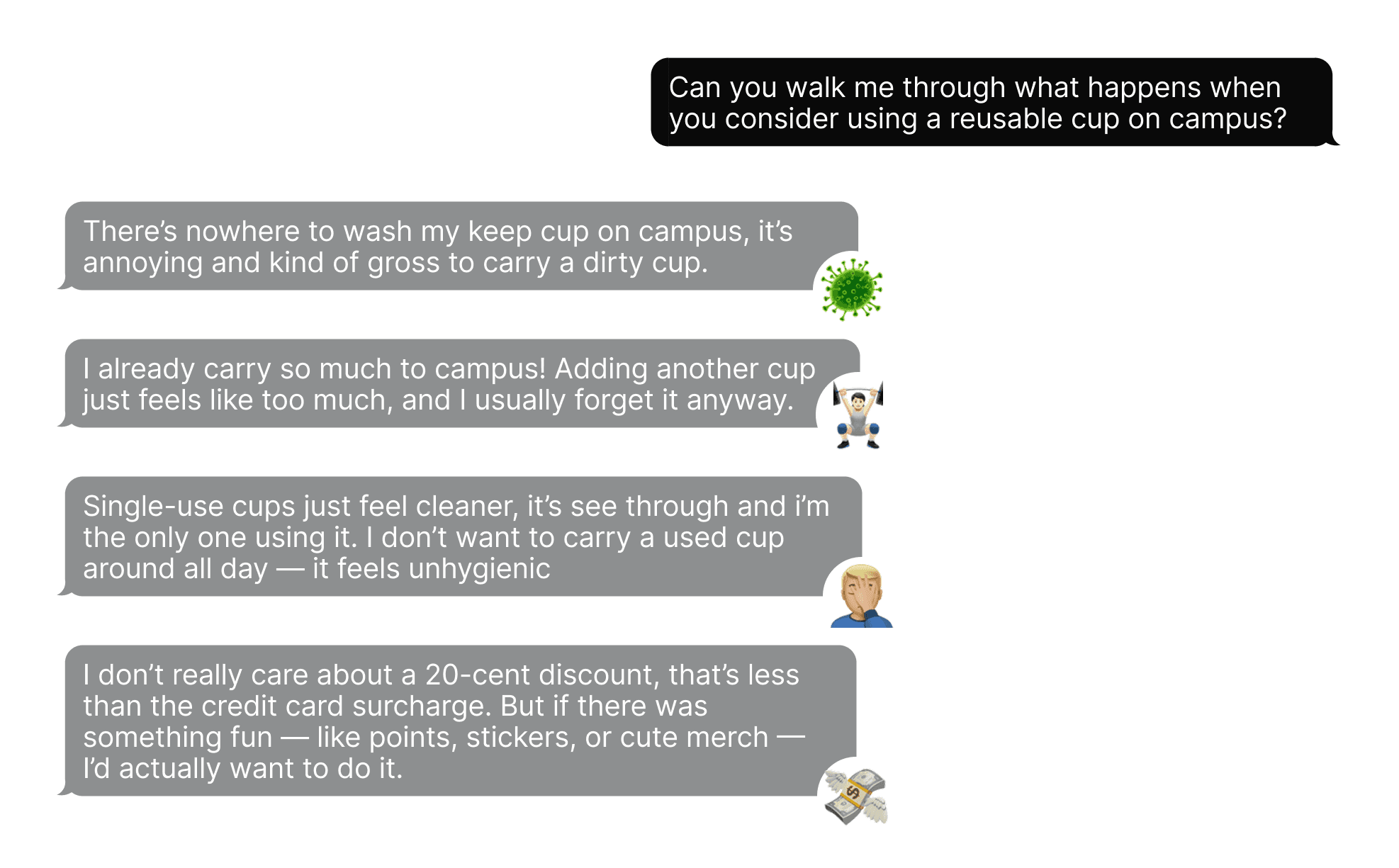
Interviewed 15 university students to understand what actually holds students back from using reusable cups — rather than what they say they value.
While reusable water bottles succeed because they are convenient and low-maintenance, our interviews revealed that reusable cups face a very different set of challenges. These conversations surfaced practical, emotional, and habitual barriers that weren’t fully visible through background research alone
REFRAMING THE HMW
Based on our research and community insights, we reframed the challenge to focus not on providing more information, but on how trust, clarity, and emotional safety are supported before and during flood events.
How might we help residents of Lismore prepare for floods in a way that is trustworthy, emotionally safe, and accessible across different ages and levels of digital literacy?
REFRAMING THE HMW
How might we design a campus wide system that makes reusable drink containers more convenient, hygienic, and rewarding than single-use cups?
APPROACHING A SOLUTION
The goal shifted from changing student behaviour to designing a system that truly support them to embrace reusables
Directly responding to key pain points from user interviews — carrying an extra cup, lack of washing facilities, and hygiene concerns — we explored a borrow-and-return reusable cup system, where cups are professionally cleaned and sanitised before being recirculated, much like a library book model
Once we aligned on a borrow-and-return system, the next question was where this system would create the most impact.
Why I championed to go beyond just coffee
Coffee is not the only source of single used drink container waste on campus
Our research showed this overlooked drink types such as bubble tea and smoothies on campus. Bubble tea is popularity is on the rise articularly with 46% of USYD students being international
Bubble tea generates significantly more plastic per drink
Bubble tea - cup, sealed lid, straw, sleeve. Coffee - cup and lid only
Tested the system in its hardest case
By designing for bubble tea, we tested the system in its hardest case and ensured the cup and service could support coffee, bubble tea, and other takeaway drinks — not just the easiest scenario.
BUILDING AND TESTING OUR PROTOTYPE
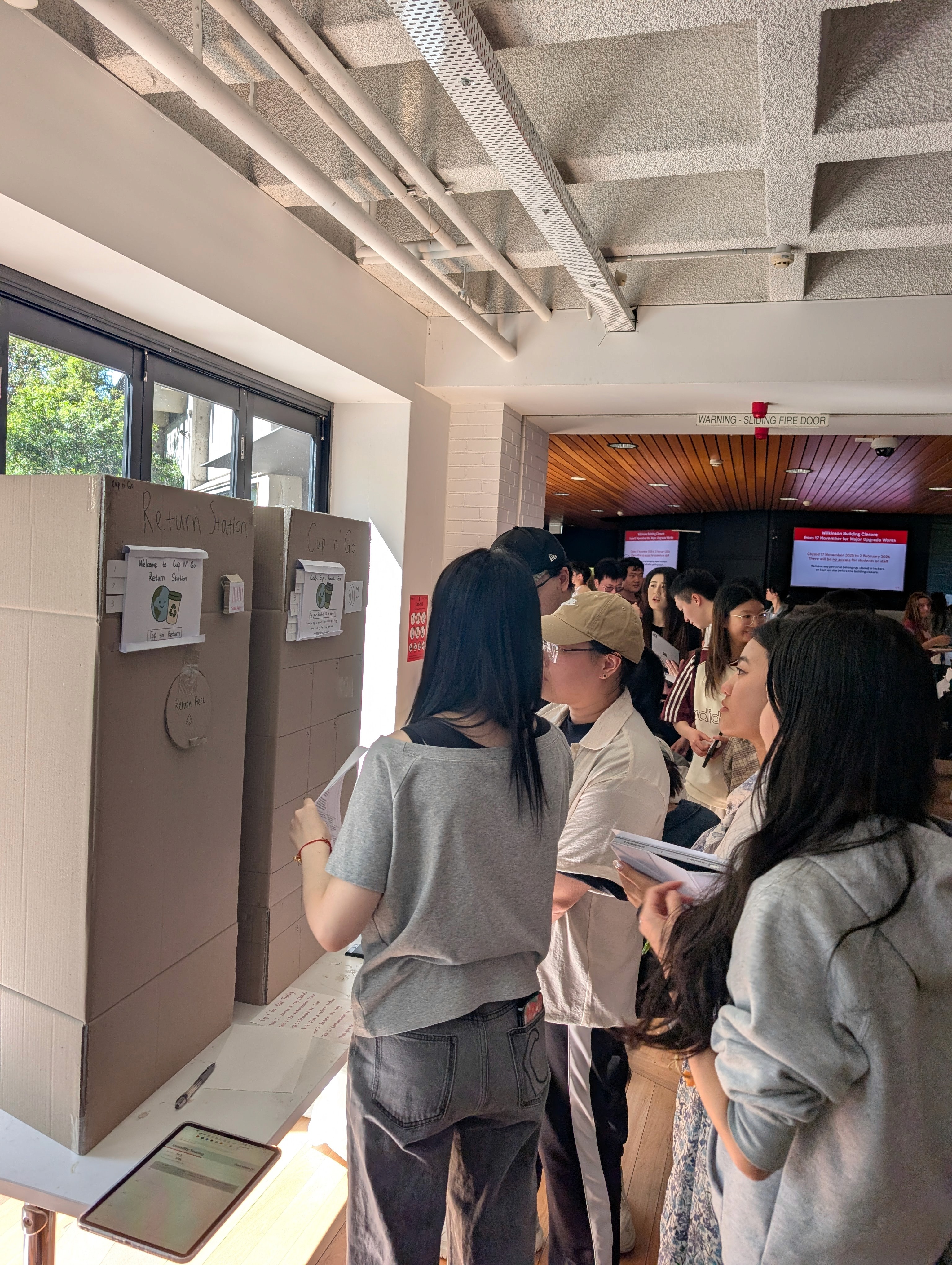
To test whether the idea would work in real life, we intentionally stayed low-fidelity, focusing on user behaviour, feasibility, and ease of use. We built two large-scale physical prototypes — a borrow locker and a return locker, using paper and cardboard, collectively referred to as Cup n’ Go. This allowed participants to interact with the whole product, not just the touchscreen.
By testing early and cheaply, we discovered critical insights that would likely have been missed in a screen-only prototype
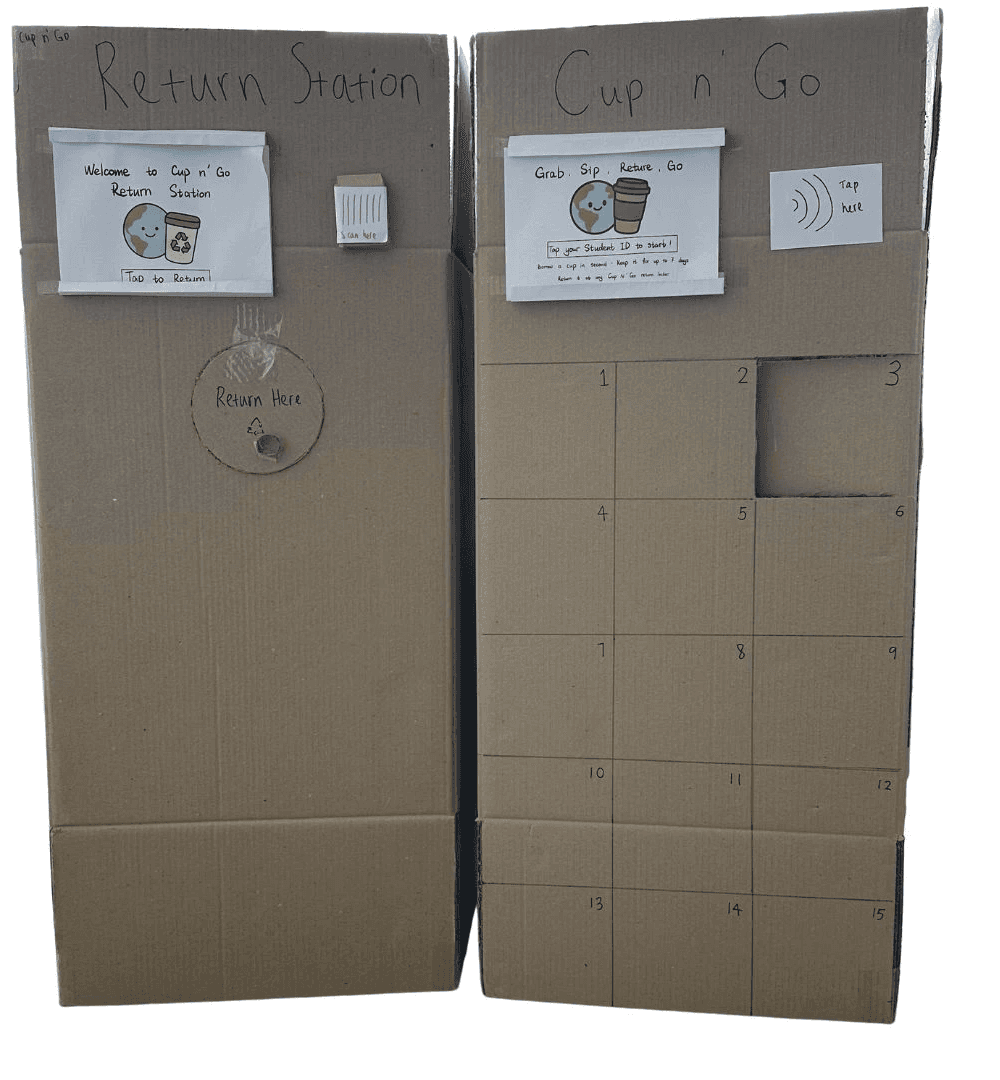
Our testing goal
Could students borrow and return a cup effortlessly — and would they feel about the credit card pre-authorisation step?
From our research, we understood that ease of use is key. It would not be adopted if it's difficult to use. Participants were asked to complete one user flow moving from the borrow to the return locker. Observations and post-test interviews helped us assess ease of use, reactions to the pre-authorisation step, and perceptions of price fairness and hygiene, all critical to long-term adoption.
DETAILS
6 Participants
Tasked based usability testing
6 tasks and 5 follow up questions
Think out loud method
System Usability Scale (SUS)
Observation and video recorded
Our testing goal
Could students borrow and return a cup effortlessly — and would they feel about the credit card pre-authorisation step?
From our research, we understood that ease of use is key. It would not be adopted if it's difficult to use. Participants were asked to complete one user flow moving from the borrow to the return locker. Observations and post-test interviews helped us assess ease of use, reactions to the pre-authorisation step, and perceptions of price fairness and hygiene, all critical to long-term adoption.
DETAILS
6 Participants
Tasked based usability testing
6 tasks and 5 follow up questions
Think out loud method
System Usability Scale (SUS)
Observation and video recorded
TASKS
Borrow a 600ml cup for bubble tea
Solving a pre-authorization credit card issue
Retrieve the cup
Find a return location
Return the cup at the return locker
Cost of the use
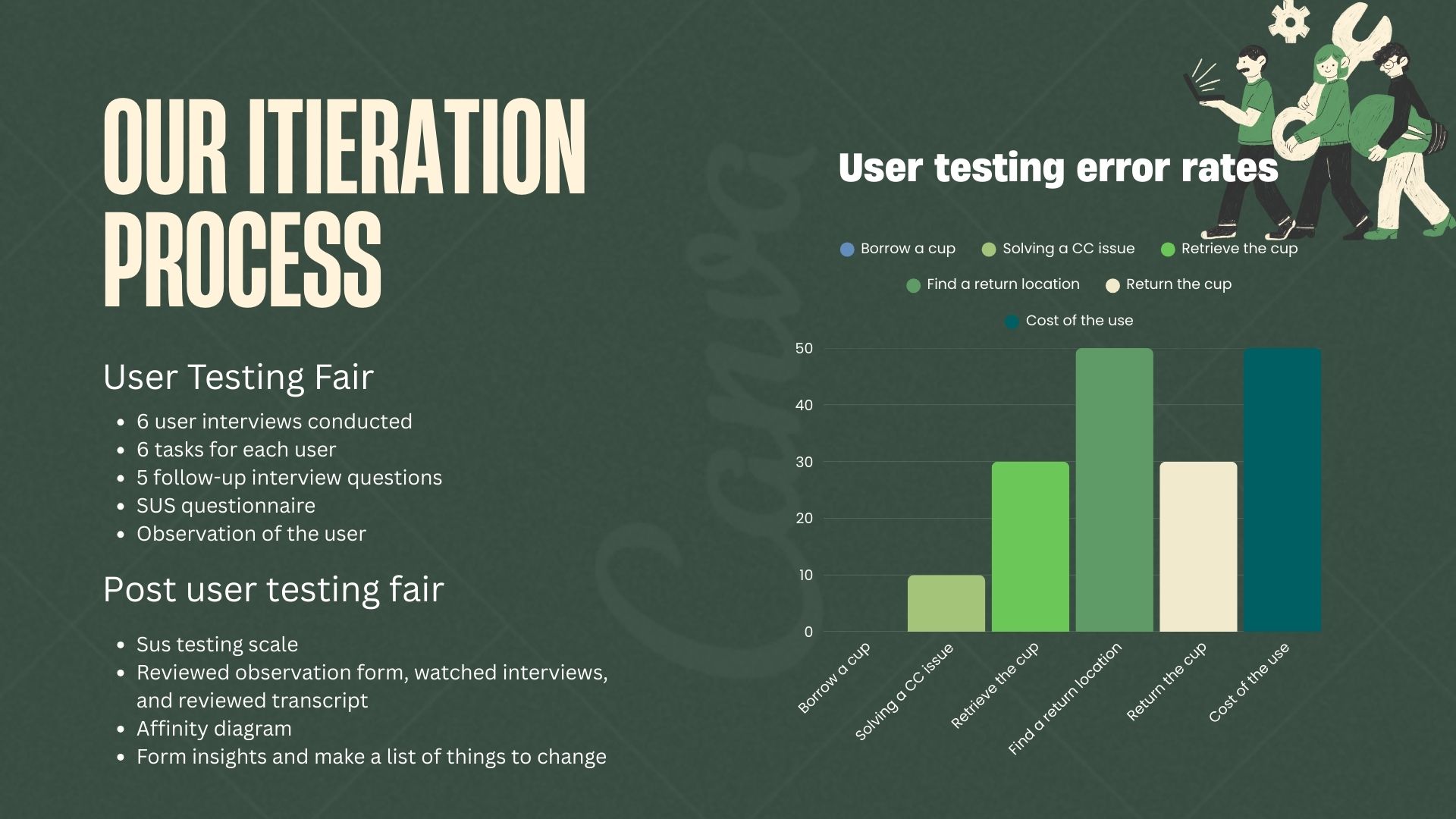
We synthesised our findings from usability testing and mapped error rates across each task to understand where users struggled most within the Cup n’ Go system.
Early steps such as borrowing a cup and solving the pre-authorisation step were completed smoothly.
Later steps — particularly retrieving the cup, finding return locations, and returning the cup — showed significantly higher error rates.
ITERATIONS
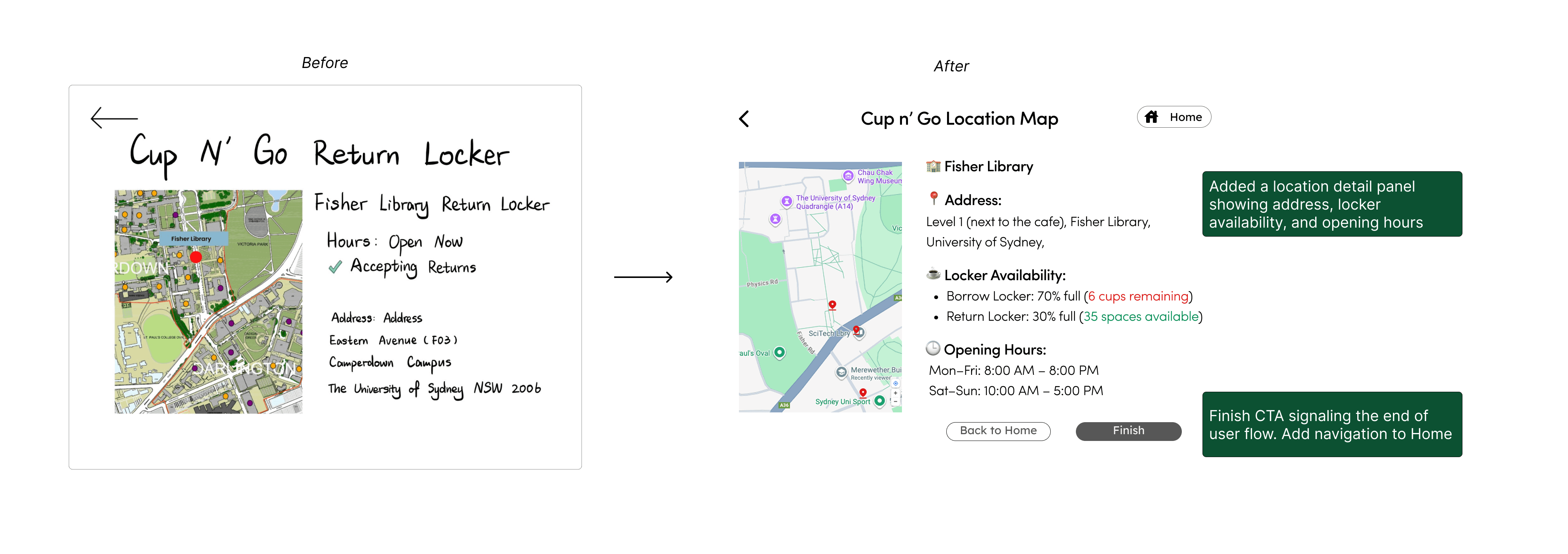
Finding a return location
PROBLEM
Only 2 out of 6 users successfully completed the task of finding a return locker. Most participants didn’t realise the map was interactive or that cups could be returned to any Cup n’ Go locker across campus.
INSIGHTS
Users expected the map to behave like tools they already knew. When interaction cues were unclear, they hesitated, second-guessed themselves, or assumed the feature didn’t work.

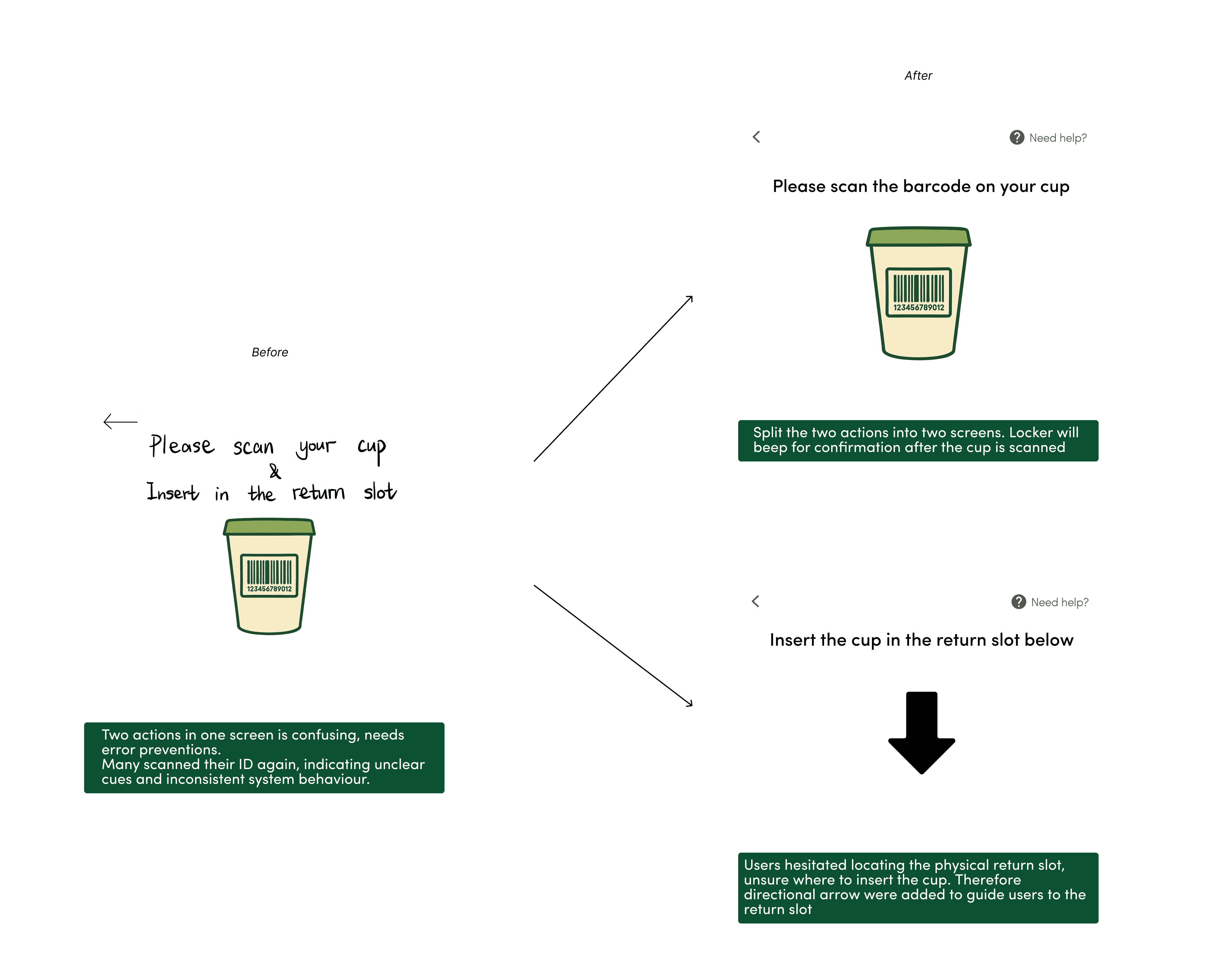
Aligning the return flow with user expectation
PROBLEM
Users defaulted to scanning their Student ID instead of tapping “Tap to return,” mirroring the borrowing flow
When prompted to scan the cup, many scanned their ID again, indicating unclear system cues and inconsistent mental models.
Several users hesitated locating the physical return slot, unsure where the cup should be inserted.
INSIGHTS
Users rely heavily on recognition over recall. When flows differ, expectations must be explicitly reset.
Inconsistent interaction patterns (scan vs tap) increase error rates and hesitation.
Physical actions require clear spatial cues, not just on-screen instructions.
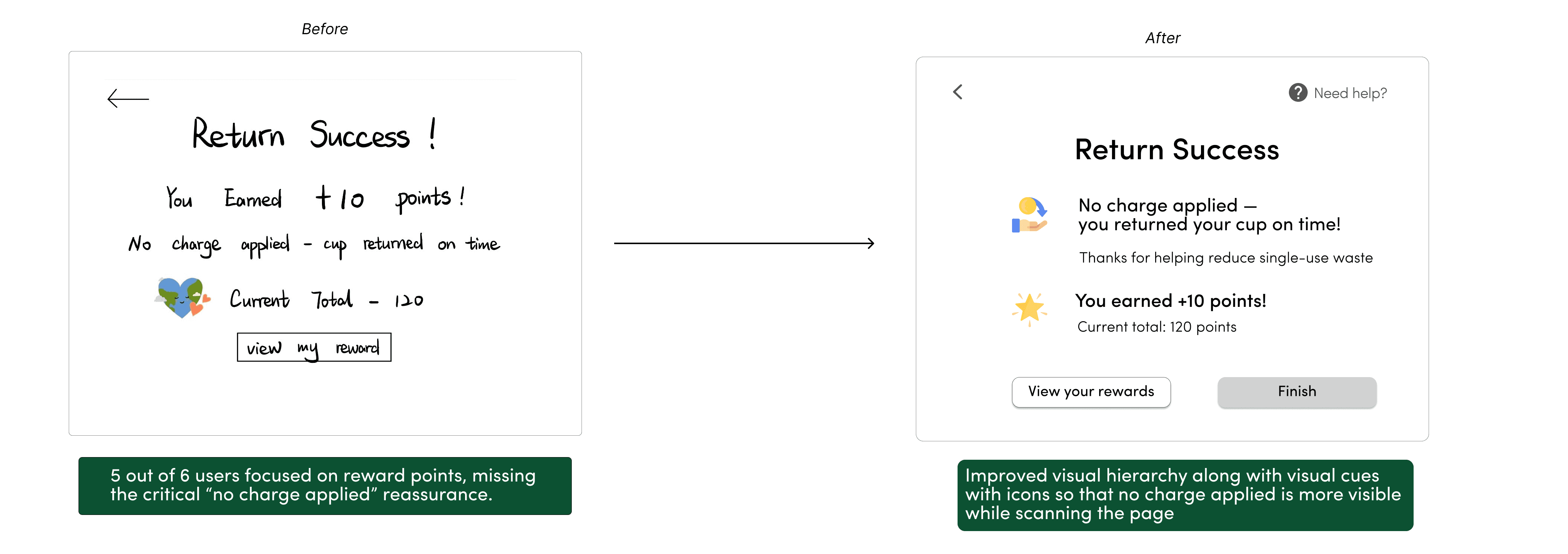
Visual hierarchy matters: “No charge applied” must outweigh secondary rewards to reduce anxiety.
FINAL SOLUTION
Cup n’ Go is a campus-wide reusable cup system designed to make reuse effortless, hygienic, and rewarding.
At the core of the service are smart borrow-and-return lockers, strategically placed across campus. There are more return stations than borrow stations, reducing friction and making it easy to return a cup wherever students already are.
View prototype
Key features
Hygienic- Cups are centrally collected, professionally washed, and redistributed — removing the need for students to clean, carry, or store reusable cups.
Low-effort borrowing - Quick access via Student ID scan or tap, designed to feel as easy as using a single-use cup.
Rewarding and gamified with blind box experience - Points and digital badges encourage timely returns without fines or guilt. Cups come in different colours, adding a small collectible element that keeps the experience playful and engaging.
Future-ready and scalable- Designed to scale beyond a single campus. Mobile app integration support expands access to non-USYD users and new locations.
Key learnings
Sitting with ambiguity before rushing to solution
This project reinforced that tools are only useful when they reflect how communities actually share information, cope, and support one another.
Designing Cup N’ Go pushed me to think beyond digital interfaces and consider the full service ecosystem — physical touchpoints, habits, incentives, and moments of drop-off. Early research and synthesis revealed how small inconveniences can quickly derail reuse behaviours, even for users who are environmentally motivated.
The project strengthened my confidence in leading design through ambiguity within a cross-disciplinary context. Guiding the design direction through moments of tension and uncertainty helped me develop stronger facilitation, communication, and decision-making skills.
Most importantly, Cup N’ Go deepened my understanding that effective human-centred design often lives in the details — where thoughtful systems make better choices feel effortless rather than enforced.
What I'd do next
Re test the iterations - Re-test updated flows with users to validate whether design changes reduced friction and improved confidence.
Testing the cup design- testing the cup design with different drink types to ensure it works seamlessly with bubble, coffee and smoothie.
Pilot & real world validation- Run a small on-campus pilot to observe real-world adoption, drop-off points, and operational challenges over time.
Key learnings
Sitting with ambiguity before rushing to solution
This project reinforced that tools are only useful when they reflect how communities actually share information, cope, and support one another.
Designing Cup N’ Go pushed me to think beyond digital interfaces and consider the full service ecosystem — physical touchpoints, habits, incentives, and moments of drop-off. Early research and synthesis revealed how small inconveniences can quickly derail reuse behaviours, even for users who are environmentally motivated.
The project strengthened my confidence in leading design through ambiguity within a cross-disciplinary context. Guiding the design direction through moments of tension and uncertainty helped me develop stronger facilitation, communication, and decision-making skills.
Most importantly, Cup N’ Go deepened my understanding that effective human-centred design often lives in the details — where thoughtful systems make better choices feel effortless rather than enforced.
What I'd do next
Re test the iterations - Re-test updated flows with users to validate whether design changes reduced friction and improved confidence.
Testing the cup design- testing the cup design with different drink types to ensure it works seamlessly with bubble, coffee and smoothie.
Pilot & real world validation- Run a small on-campus pilot to observe real-world adoption, drop-off points, and operational challenges over time.
Key learnings
Sitting with ambiguity before rushing to solution
This project reinforced that tools are only useful when they reflect how communities actually share information, cope, and support one another.
Designing Cup N’ Go pushed me to think beyond digital interfaces and consider the full service ecosystem — physical touchpoints, habits, incentives, and moments of drop-off. Early research and synthesis revealed how small inconveniences can quickly derail reuse behaviours, even for users who are environmentally motivated.
The project strengthened my confidence in leading design through ambiguity within a cross-disciplinary context. Guiding the design direction through moments of tension and uncertainty helped me develop stronger facilitation, communication, and decision-making skills.
Most importantly, Cup N’ Go deepened my understanding that effective human-centred design often lives in the details — where thoughtful systems make better choices feel effortless rather than enforced.
What I'd do with more time
Re test the iterations - Re-test updated flows with users to validate whether design changes reduced friction and improved confidence.
Testing the cup design- testing the cup design with different drink types to ensure it works seamlessly with bubble, coffee and smoothie.
Pilot & real world validation- Run a small on-campus pilot to observe real-world adoption, drop-off points, and operational challenges over time.
Cup n' Go
A service design product for university campus tackling single-use waste through supporting behaviour change
INTRODUCTION
Cup n' Go is a service design product exploring how behaviour change can reduce single-use cup waste. It reframes the problem from awareness to systems, shaped by user interviews that revealed why good intentions alone don’t lead to reuse.
MY ROLE
I led the UX design work within a cross-disciplinary team of five, collaborating with teammates from computer science backgrounds.
Conducted user research and interviews, contributing insights that informed the overall problem framing
Led ideation and concept development, proposing the shared cup and locker system that became the final direction
Planned and facilitated user testing using low-fidelity prototypes to validate behaviour change and system feasibility
Led the synthesis of user feedback, consolidating findings across multiple testing rounds into clear insights and design decisions
INTRODUCTION
Guardly is a UX-led product developed during a 48-hour designathon, exploring how moment-based interventions can support job seekers at the point where scams are most likely to occur.
[Project Scope]
Team of 5
[Role]
Project led, UX Design
[Tools]
Paper & cardboard prototype
Figma
[Timeline]
10 weeks
View prototype
PROBLEM DISCOVERY
Most students want to be sustainable — but their daily routines make it hard to act that way
On campus, sustainability awareness is high. Many students carry reusable water bottles and understand the environmental impact of single-use plastics. Yet takeaway coffee and bubble tea cups remain one of the largest sources of daily waste at the University of Sydney.
Through conversations with students at campus cafés and food courts, a clear pattern emerged: the issue wasn’t motivation, but practicality. Students commute with heavy backpacks, walk long distances between buildings, and juggle busy schedules. Carrying — and cleaning — an extra reusable cup felt impractical.
Single-use cups, by contrast, were effortless, familiar, and easy to forget once discarded. This sparked a question:
"How might we design a campus wide system at the University of Sydney that makes reusable drink containers more convenient, hygienic, and rewarding than single-use cups?
PROBLEM DISCOVERY
Most students want to be sustainable — but their daily routines make it hard to act that way
On campus, sustainability awareness is high. Many students carry reusable water bottles and understand the environmental impact of single-use plastics. Yet takeaway coffee and bubble tea cups remain one of the largest sources of daily waste at the University of Sydney.
Through conversations with students at campus cafés and food courts, a clear pattern emerged: the issue wasn’t motivation, but practicality. Students commute with heavy backpacks, walk long distances between buildings, and juggle busy schedules. Carrying — and cleaning — an extra reusable cup felt impractical.
Single-use cups, by contrast, were effortless, familiar, and easy to forget once discarded. This sparked a question:
“How might we empower users to confidently spot and report job scams so they can protect their personal information from online predators?”
Our Solution - Resilient Lismore
A reusable cup locker system designed to integrate reuse into everyday routines
WITHOUT requiring students to own, carry, or remember to bring a reusable cup
How does it work?
Borrow — Students borrow a reusable cup from a self-service Cup n Go locker at participating campus cafés.
Use — The cup can be used for coffee or bubble tea and kept for up to 7 days, fitting naturally into students’ routines.
Return — Cups are returned to any Cup n Go return locker across campus, then collected, professionally washed, and redistributed back into the system.
The Process
STARTING POINT - UNDERSTANDING THE WHY
Single-use cup waste is a widely recognised sustainability issue, yet behaviour at scale has barely changed. I began this project by trying to understand why —
Why disposable takeaway cups remain so embedded in daily routines despite years of awareness campaigns, incentives, and media attention?
Hand-drawn sketch note capturing early research insights and hypotheses
What doesn't work
Financial incentives
Small discounts for reusable cups were shown to have no impact on daily decisions — a finding supported by both academic research (Sandhu et al., 2021) and UN sustainability frameworks.
Ignoring emotional association
Takeaway drinks are often linked to indulgence, and better taste. For many users, the takeaway coffee cups feel more “treat-like” and less homemade
What works
Mimetic behaviour
Seeing others reuse cups and visibly participate in sustainable behaviour encourages adoption more effectively than abstract messaging.
Awareness campaigns (short term)
Documentaries, public installations, and sustainability messaging are effective but it’s short term, and the effect fades quickly
What doesn't work
Financial incentives
Small discounts for reusable cups were shown to have no impact on daily decisions — a finding supported by both academic research (Sandhu et al., 2021) and UN sustainability frameworks.
Ignoring emotional association
Takeaway drinks are often linked to indulgence, and better taste. For many users, the takeaway coffee cups feel more “treat-like” and less homemade
What works
Mimetic behaviour
Seeing others reuse cups and visibly participate in sustainable behaviour encourages adoption more effectively than abstract messaging.
Awareness campaigns (short term)
Documentaries, public installations, and sustainability messaging are effective but it’s short term, and the effect fades quickly
TALKING TO OUR USERS
Interviewed 15 university students to understand what actually holds students back from using reusable cups — rather than what they say they value.
While reusable water bottles succeed because they are convenient and low-maintenance, our interviews revealed that reusable cups face a very different set of challenges. These conversations surfaced practical, emotional, and habitual barriers that weren’t fully visible through background research alone
REFRAMING THE HMW
Based on our research and community insights, we reframed the challenge to focus not on providing more information, but on how trust, clarity, and emotional safety are supported before and during flood events.
How might we help residents of Lismore prepare for floods in a way that is trustworthy, emotionally safe, and accessible across different ages and levels of digital literacy?
REFRAMING THE HMW
How might we design a campus wide system that makes reusable drink containers more convenient, hygienic, and rewarding than single-use cups?
APPROACHING A SOLUTION
The goal shifted from changing student behaviour to designing a system that truly support them to embrace reusables
Directly responding to key pain points from user interviews — carrying an extra cup, lack of washing facilities, and hygiene concerns — we explored a borrow-and-return reusable cup system, where cups are professionally cleaned and sanitised before being recirculated, much like a library book model
Once we aligned on a borrow-and-return system, the next question was where this system would create the most impact.
Why I championed to go beyond just coffee
Coffee is not the only source of single used drink container waste on campus
Our research showed this overlooked drink types such as bubble tea and smoothies on campus. Bubble tea is popularity is on the rise articularly with 46% of USYD students being international
Bubble tea generates significantly more plastic per drink
Bubble tea - cup, sealed lid, straw, sleeve. Coffee - cup and lid only
Tested the system in its hardest case
By designing for bubble tea, we tested the system in its hardest case and ensured the cup and service could support coffee, bubble tea, and other takeaway drinks — not just the easiest scenario.
BUILDING AND TESTING OUR PROTOTYPE
To test whether the idea would work in real life, we intentionally stayed low-fidelity, focusing on user behaviour, feasibility, and ease of use. We built two large-scale physical prototypes — a borrow locker and a return locker, using paper and cardboard, collectively referred to as Cup n’ Go. This allowed participants to interact with the whole product, not just the touchscreen.
By testing early and cheaply, we discovered critical insights that would likely have been missed in a screen-only prototype
Our testing goal
Could students borrow and return a cup effortlessly — and would they feel about the credit card pre-authorisation step?
From our research, we understood that ease of use is key. It would not be adopted if it's difficult to use. Participants were asked to complete one user flow moving from the borrow to the return locker. Observations and post-test interviews helped us assess ease of use, reactions to the pre-authorisation step, and perceptions of price fairness and hygiene, all critical to long-term adoption.
DETAILS
6 Participants
Tasked based usability testing
6 tasks and 5 follow up questions
Think out loud method
System Usability Scale (SUS)
Observation and video recorded
Our testing goal
Could students borrow and return a cup effortlessly — and would they feel about the credit card pre-authorisation step?
From our research, we understood that ease of use is key. It would not be adopted if it's difficult to use. Participants were asked to complete one user flow moving from the borrow to the return locker. Observations and post-test interviews helped us assess ease of use, reactions to the pre-authorisation step, and perceptions of price fairness and hygiene, all critical to long-term adoption.
DETAILS
6 Participants
Tasked based usability testing
6 tasks and 5 follow up questions
Think out loud method
System Usability Scale (SUS)
Observation and video recorded
TASKS
Borrow a 600ml cup for bubble tea
Solving a pre-authorization credit card issue
Retrieve the cup
Find a return location
Return the cup at the return locker
Cost of the use
We synthesised our findings from usability testing and mapped error rates across each task to understand where users struggled most within the Cup n’ Go system.
Early steps such as borrowing a cup and solving the pre-authorisation step were completed smoothly.
Later steps — particularly retrieving the cup, finding return locations, and returning the cup — showed significantly higher error rates.
ITERATIONS
Finding a return location
PROBLEM
Only 2 out of 6 users successfully completed the task of finding a return locker. Most participants didn’t realise the map was interactive or that cups could be returned to any Cup n’ Go locker across campus.
INSIGHTS
Users expected the map to behave like tools they already knew. When interaction cues were unclear, they hesitated, second-guessed themselves, or assumed the feature didn’t work.
Aligning the return flow with user expectation
PROBLEM
Users defaulted to scanning their Student ID instead of tapping “Tap to return,” mirroring the borrowing flow
When prompted to scan the cup, many scanned their ID again, indicating unclear system cues and inconsistent mental models.
Several users hesitated locating the physical return slot, unsure where the cup should be inserted.
INSIGHTS
Users rely heavily on recognition over recall. When flows differ, expectations must be explicitly reset.
Inconsistent interaction patterns (scan vs tap) increase error rates and hesitation.
Physical actions require clear spatial cues, not just on-screen instructions.
Visual hierarchy matters: “No charge applied” must outweigh secondary rewards to reduce anxiety.
FINAL SOLUTION
Cup n’ Go is a campus-wide reusable cup system designed to make reuse effortless, hygienic, and rewarding.
At the core of the service are smart borrow-and-return lockers, strategically placed across campus. There are more return stations than borrow stations, reducing friction and making it easy to return a cup wherever students already are.
View prototype
Key features
Hygienic- Cups are centrally collected, professionally washed, and redistributed — removing the need for students to clean, carry, or store reusable cups.
Low-effort borrowing - Quick access via Student ID scan or tap, designed to feel as easy as using a single-use cup.
Rewarding and gamified with blind box experience - Points and digital badges encourage timely returns without fines or guilt. Cups come in different colours, adding a small collectible element that keeps the experience playful and engaging.
Future-ready and scalable- Designed to scale beyond a single campus. Mobile app integration support expands access to non-USYD users and new locations.
Key learnings
Sitting with ambiguity before rushing to solution
This project reinforced that tools are only useful when they reflect how communities actually share information, cope, and support one another.
Designing Cup N’ Go pushed me to think beyond digital interfaces and consider the full service ecosystem — physical touchpoints, habits, incentives, and moments of drop-off. Early research and synthesis revealed how small inconveniences can quickly derail reuse behaviours, even for users who are environmentally motivated.
The project strengthened my confidence in leading design through ambiguity within a cross-disciplinary context. Guiding the design direction through moments of tension and uncertainty helped me develop stronger facilitation, communication, and decision-making skills.
Most importantly, Cup N’ Go deepened my understanding that effective human-centred design often lives in the details — where thoughtful systems make better choices feel effortless rather than enforced.
What I'd do next
Re test the iterations - Re-test updated flows with users to validate whether design changes reduced friction and improved confidence.
Testing the cup design- testing the cup design with different drink types to ensure it works seamlessly with bubble, coffee and smoothie.
Pilot & real world validation- Run a small on-campus pilot to observe real-world adoption, drop-off points, and operational challenges over time.
Key learnings
Sitting with ambiguity before rushing to solution
This project reinforced that tools are only useful when they reflect how communities actually share information, cope, and support one another.
Designing Cup N’ Go pushed me to think beyond digital interfaces and consider the full service ecosystem — physical touchpoints, habits, incentives, and moments of drop-off. Early research and synthesis revealed how small inconveniences can quickly derail reuse behaviours, even for users who are environmentally motivated.
The project strengthened my confidence in leading design through ambiguity within a cross-disciplinary context. Guiding the design direction through moments of tension and uncertainty helped me develop stronger facilitation, communication, and decision-making skills.
Most importantly, Cup N’ Go deepened my understanding that effective human-centred design often lives in the details — where thoughtful systems make better choices feel effortless rather than enforced.
What I'd do next
Re test the iterations - Re-test updated flows with users to validate whether design changes reduced friction and improved confidence.
Testing the cup design- testing the cup design with different drink types to ensure it works seamlessly with bubble, coffee and smoothie.
Pilot & real world validation- Run a small on-campus pilot to observe real-world adoption, drop-off points, and operational challenges over time.
Key learnings
Sitting with ambiguity before rushing to solution
This project reinforced that tools are only useful when they reflect how communities actually share information, cope, and support one another.
Designing Cup N’ Go pushed me to think beyond digital interfaces and consider the full service ecosystem — physical touchpoints, habits, incentives, and moments of drop-off. Early research and synthesis revealed how small inconveniences can quickly derail reuse behaviours, even for users who are environmentally motivated.
The project strengthened my confidence in leading design through ambiguity within a cross-disciplinary context. Guiding the design direction through moments of tension and uncertainty helped me develop stronger facilitation, communication, and decision-making skills.
Most importantly, Cup N’ Go deepened my understanding that effective human-centred design often lives in the details — where thoughtful systems make better choices feel effortless rather than enforced.
What I'd do with more time
Re test the iterations - Re-test updated flows with users to validate whether design changes reduced friction and improved confidence.
Testing the cup design- testing the cup design with different drink types to ensure it works seamlessly with bubble, coffee and smoothie.
Pilot & real world validation- Run a small on-campus pilot to observe real-world adoption, drop-off points, and operational challenges over time.
Cup n' Go
A service design product for university campus tackling single-use waste through supporting behaviour change
INTRODUCTION
Cup n' Go is a service design product exploring how behaviour change can reduce single-use cup waste. It reframes the problem from awareness to systems, shaped by user interviews that revealed why good intentions alone don’t lead to reuse.
MY ROLE
I led the UX design work within a cross-disciplinary team of five, collaborating with teammates from computer science backgrounds.
Conducted user research and interviews, contributing insights that informed the overall problem framing
Led ideation and concept development, proposing the shared cup and locker system that became the final direction
Planned and facilitated user testing using low-fidelity prototypes to validate behaviour change and system feasibility
Led the synthesis of user feedback, consolidating findings across multiple testing rounds into clear insights and design decisions
INTRODUCTION
Guardly is a UX-led product developed during a 48-hour designathon, exploring how moment-based interventions can support job seekers at the point where scams are most likely to occur.
[Project Scope]
Team of 5
[Role]
Project led, UX Design
[Tools]
Paper & cardboard prototype
Figma
[Timeline]
10 weeks
View prototype
PROBLEM DISCOVERY
Most students want to be sustainable — but their daily routines make it hard to act that way
On campus, sustainability awareness is high. Many students carry reusable water bottles and understand the environmental impact of single-use plastics. Yet takeaway coffee and bubble tea cups remain one of the largest sources of daily waste at the University of Sydney.
Through conversations with students at campus cafés and food courts, a clear pattern emerged: the issue wasn’t motivation, but practicality. Students commute with heavy backpacks, walk long distances between buildings, and juggle busy schedules. Carrying — and cleaning — an extra reusable cup felt impractical.
Single-use cups, by contrast, were effortless, familiar, and easy to forget once discarded. This sparked a question:
"How might we design a campus wide system at the University of Sydney that makes reusable drink containers more convenient, hygienic, and rewarding than single-use cups?
PROBLEM DISCOVERY
Most students want to be sustainable — but their daily routines make it hard to act that way
On campus, sustainability awareness is high. Many students carry reusable water bottles and understand the environmental impact of single-use plastics. Yet takeaway coffee and bubble tea cups remain one of the largest sources of daily waste at the University of Sydney.
Through conversations with students at campus cafés and food courts, a clear pattern emerged: the issue wasn’t motivation, but practicality. Students commute with heavy backpacks, walk long distances between buildings, and juggle busy schedules. Carrying — and cleaning — an extra reusable cup felt impractical.
Single-use cups, by contrast, were effortless, familiar, and easy to forget once discarded. This sparked a question:
“How might we empower users to confidently spot and report job scams so they can protect their personal information from online predators?”
Our Solution - Resilient Lismore
A reusable cup locker system designed to integrate reuse into everyday routines
without requiring students to own, carry, or remember to bring a reusable cup
How does it work?
Borrow — Students borrow a reusable cup from a self-service Cup n Go locker at participating campus cafés.
Use — The cup can be used for coffee or bubble tea and kept for up to 7 days, fitting naturally into students’ routines.
Return — Cups are returned to any Cup n Go return locker across campus, then collected, professionally washed, and redistributed back into the system.
The Process
STARTING POINT - UNDERSTANDING THE WHY
Single-use cup waste is a widely recognised sustainability issue, yet behaviour at scale has barely changed. I began this project by trying to understand why
Why are disposable takeaway cups remain so embedded in daily routines despite years of awareness campaigns, incentives, and media attention?
Hand-drawn sketch note capturing early research insights and hypotheses
What doesn't work
Financial incentives
Small discounts for reusable cups were shown to have no impact on daily decisions — a finding supported by both academic research (Sandhu et al., 2021) and UN sustainability frameworks.
Ignoring emotional association
Takeaway drinks are often linked to indulgence, and better taste. For many users, the takeaway coffee cups feel more “treat-like” and less homemade
What works
Mimetic behaviour
Seeing others reuse cups and visibly participate in sustainable behaviour encourages adoption more effectively than abstract messaging.
Awareness campaigns (short term)
Documentaries, public installations, and sustainability messaging are effective but it’s short term, and the effect fades quickly
What doesn't work
Financial incentives
Small discounts for reusable cups were shown to have no impact on daily decisions — a finding supported by both academic research (Sandhu et al., 2021) and UN sustainability frameworks.
Ignoring emotional association
Takeaway drinks are often linked to indulgence, and better taste. For many users, the takeaway coffee cups feel more “treat-like” and less homemade
What works
Mimetic behaviour
Seeing others reuse cups and visibly participate in sustainable behaviour encourages adoption more effectively than abstract messaging.
Awareness campaigns (short term)
Documentaries, public installations, and sustainability messaging are effective but it’s short term, and the effect fades quickly
TALKING TO OUR USERS
Interviewed 15 university students to understand what actually holds students back from using reusable cups — rather than what they say they value.
While reusable water bottles succeed because they are convenient and low-maintenance, our interviews revealed that reusable cups face a very different set of challenges. These conversations surfaced practical, emotional, and habitual barriers that weren’t fully visible through background research alone
REFRAMING THE HMW
Based on our research and community insights, we reframed the challenge to focus not on providing more information, but on how trust, clarity, and emotional safety are supported before and during flood events.
How might we help residents of Lismore prepare for floods in a way that is trustworthy, emotionally safe, and accessible across different ages and levels of digital literacy?
REFRAMING THE HMW
How might we design a campus wide system that makes reusable drink containers more convenient, hygienic, and rewarding than single-use cups?
APPROACHING A SOLUTION
The goal shifted from changing student behaviour to designing a system that truly support them to embrace reusables
Directly responding to key pain points from user interviews — carrying an extra cup, lack of washing facilities, and hygiene concerns — we explored a borrow-and-return reusable cup system, where cups are professionally cleaned and sanitised before being recirculated, much like a library book model
Once we aligned on a borrow-and-return system, the next question was where this system would create the most impact.
Why I championed to go beyond just coffee
Coffee is not the only source of single used drink container waste on campus
Our research showed this overlooked drink types such as bubble tea and smoothies on campus. Bubble tea is popularity is on the rise articularly with 46% of USYD students being international
Bubble tea generates significantly more plastic per drink
Bubble tea - cup, sealed lid, straw, sleeve. Coffee - cup and lid only
Tested the system in its hardest case
By designing for bubble tea, we tested the system in its hardest case and ensured the cup and service could support coffee, bubble tea, and other takeaway drinks — not just the easiest scenario.
BUILDING AND TESTING OUR PROTOTYPE
To test whether the idea would work in real life, we intentionally stayed low-fidelity, focusing on user behaviour, feasibility, and ease of use. We built two large-scale physical prototypes — a borrow locker and a return locker, using paper and cardboard, collectively referred to as Cup n’ Go. This allowed participants to interact with the whole product, not just the touchscreen.
By testing early and cheaply, we discovered critical insights that would likely have been missed in a screen-only prototype
Our testing goal
Could students borrow and return a cup effortlessly — and would they feel about the credit card pre-authorisation step?
From our research, we understood that ease of use is key. It would not be adopted if it's difficult to use. Participants were asked to complete one user flow moving from the borrow to the return locker. Observations and post-test interviews helped us assess ease of use, reactions to the pre-authorisation step, and perceptions of price fairness and hygiene, all critical to long-term adoption.
DETAILS
6 Participants
Tasked based usability testing
6 tasks and 5 follow up questions
Think out loud method
System Usability Scale (SUS)
Observation and video recorded
Our testing goal
Could students borrow and return a cup effortlessly — and would they feel about the credit card pre-authorisation step?
From our research, we understood that ease of use is key. It would not be adopted if it's difficult to use. Participants were asked to complete one user flow moving from the borrow to the return locker. Observations and post-test interviews helped us assess ease of use, reactions to the pre-authorisation step, and perceptions of price fairness and hygiene, all critical to long-term adoption.
DETAILS
6 Participants
Tasked based usability testing
6 tasks and 5 follow up questions
Think out loud method
System Usability Scale (SUS)
Observation and video recorded
TASKS
Borrow a 600ml cup for bubble tea
Solving a pre-authorization issue
Retrieve the cup
Find a return location
Return the cup at the return locker
Cost of the use
We synthesised our findings from usability testing and mapped error rates across each task to understand where users struggled most within the Cup n’ Go system.
Early steps such as borrowing a cup and solving the pre-authorisation step were completed smoothly.
Later steps — particularly retrieving the cup, finding return locations, and returning the cup — showed significantly higher error rates.
ITERATIONS
Finding a return location
PROBLEM
Only 2 out of 6 users successfully completed the task of finding a return locker. Most participants didn’t realise the map was interactive or that cups could be returned to any Cup n’ Go locker across campus.
INSIGHTS
Users expected the map to behave like tools they already knew. When interaction cues were unclear, they hesitated, second-guessed themselves, or assumed the feature didn’t work.
Aligning the return flow with user expectation
PROBLEM
Users defaulted to scanning their Student ID instead of tapping “Tap to return,” mirroring the borrowing flow
When prompted to scan the cup, many scanned their ID again, indicating unclear system cues and inconsistent mental models.
Several users hesitated locating the physical return slot, unsure where the cup should be inserted.
INSIGHTS
Users rely heavily on recognition over recall. When flows differ, expectations must be explicitly reset.
Inconsistent interaction patterns (scan vs tap) increase error rates and hesitation.
Physical actions require clear spatial cues, not just on-screen instructions.
Visual hierarchy matters: “No charge applied” must outweigh secondary rewards to reduce anxiety.
FINAL SOLUTION
Cup n’ Go is a campus-wide reusable cup system designed to make reuse effortless, hygienic, and rewarding.
At the core of the service are smart borrow-and-return lockers, strategically placed across campus. There are more return stations than borrow stations, reducing friction and making it easy to return a cup wherever students already are.
View prototype
Key features
Hygienic- Cups are centrally collected, professionally washed, and redistributed — removing the need for students to clean, carry, or store reusable cups.
Low-effort borrowing - Quick access via Student ID scan or tap, designed to feel as easy as using a single-use cup.
Rewarding and gamified with blind box experience - Points and digital badges encourage timely returns without fines or guilt. Cups come in different colours, adding a small collectible element that keeps the experience playful and engaging.
Future-ready and scalable- Designed to scale beyond a single campus. Mobile app integration support expands access to non-USYD users and new locations.
Key learnings
Sitting with ambiguity before rushing to solution
This project reinforced that tools are only useful when they reflect how communities actually share information, cope, and support one another.
Designing Cup N’ Go pushed me to think beyond digital interfaces and consider the full service ecosystem — physical touchpoints, habits, incentives, and moments of drop-off. Early research and synthesis revealed how small inconveniences can quickly derail reuse behaviours, even for users who are environmentally motivated.
The project strengthened my confidence in leading design through ambiguity within a cross-disciplinary context. Guiding the design direction through moments of tension and uncertainty helped me develop stronger facilitation, communication, and decision-making skills.
Most importantly, Cup N’ Go deepened my understanding that effective human-centred design often lives in the details — where thoughtful systems make better choices feel effortless rather than enforced.
What I'd do next
Re test the iterations - Re-test updated flows with users to validate whether design changes reduced friction and improved confidence.
Testing the cup design- testing the cup design with different drink types to ensure it works seamlessly with bubble, coffee and smoothie.
Pilot & real world validation- Run a small on-campus pilot to observe real-world adoption, drop-off points, and operational challenges over time.
Key learnings
Sitting with ambiguity before rushing to solution
This project reinforced that tools are only useful when they reflect how communities actually share information, cope, and support one another.
Designing Cup N’ Go pushed me to think beyond digital interfaces and consider the full service ecosystem — physical touchpoints, habits, incentives, and moments of drop-off. Early research and synthesis revealed how small inconveniences can quickly derail reuse behaviours, even for users who are environmentally motivated.
The project strengthened my confidence in leading design through ambiguity within a cross-disciplinary context. Guiding the design direction through moments of tension and uncertainty helped me develop stronger facilitation, communication, and decision-making skills.
Most importantly, Cup N’ Go deepened my understanding that effective human-centred design often lives in the details — where thoughtful systems make better choices feel effortless rather than enforced.
What I'd do next
Re test the iterations - Re-test updated flows with users to validate whether design changes reduced friction and improved confidence.
Testing the cup design- testing the cup design with different drink types to ensure it works seamlessly with bubble, coffee and smoothie.
Pilot & real world validation- Run a small on-campus pilot to observe real-world adoption, drop-off points, and operational challenges over time.
Key learnings
Sitting with ambiguity before rushing to solution
This project reinforced that tools are only useful when they reflect how communities actually share information, cope, and support one another.
Designing Cup N’ Go pushed me to think beyond digital interfaces and consider the full service ecosystem — physical touchpoints, habits, incentives, and moments of drop-off. Early research and synthesis revealed how small inconveniences can quickly derail reuse behaviours, even for users who are environmentally motivated.
The project strengthened my confidence in leading design through ambiguity within a cross-disciplinary context. Guiding the design direction through moments of tension and uncertainty helped me develop stronger facilitation, communication, and decision-making skills.
Most importantly, Cup N’ Go deepened my understanding that effective human-centred design often lives in the details — where thoughtful systems make better choices feel effortless rather than enforced.